Researchers find new source of coherent light
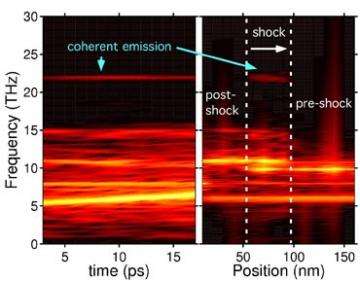
Livermore researchers find new source of coherent light. This figure shows the emission of coherent light at 22 THz from a molecular dynamics simulation of shocked NaCl (table salt). The left panel shows the emission of the light as a function of time while the shock is propagating. The right panel shows the generated radiation as a function of location within the shocked crystal indicating the 22 THz coherent signal is generated at the shock front (between the white dotted lines).
With the exception of lasers and free-electron lasers, there hasn't been another fundamental way to produce coherent light for close to 50 years. However, a group of researchers from Lawrence Livermore National Laboratory and the Massachusetts Institute of Technology have found a new source of coherent optical radiation that is distinct from lasers and free-electron lasers.
Applications from this research are numerous, but the most immediate result may be a new diagnostic tool to determine the properties of shock waves, said Evan Reed, an E.O. Lawrence postdoctoral fellow at Lawrence Livermore and lead author of a paper that appears in the Jan. 13 edition of Physical Review Letters.
Through a series of theoretical calculations and experimental simulations, scientists generated a mechanical shock wave inside a dielectric crystalline material, in this case kitchen salt (NaCl). One might expect to see only incoherent photons and sparks from the shocked crystal.
But what they found was so much more. Weak yet measurable coherent light was seen emerging from the crystal. The emission frequencies are determined by the shock speed and the lattice make-up of the crystal.
The team found that measurable coherent light can be observed emerging from the crystal in the range of 1 to 100 terahertz (THz).
"To our knowledge, coherent light never has been seen before from shock waves propagating through crystals because a shocked crystal is not an obvious source to look for coherent radiation," Reed said. "The light and radiation was in a portion of the electromagnetic spectrum that is not usually observed in these types of experiments."
Coherent light is very narrow bandwidth radiation; it is useful for interferometry (the measurement of two or more waves coming together at the same time and place, such as optical and shock waves) and is usually associated with lasers.
The invention of the laser in 1958 as a source of coherent light enabled a wide range of applications including medical technologies and energy production because of the coherence of the light they generate. However, producing coherent light from a source other than a laser can serve as a diagnostic for understanding shock waves, specifically providing information about shock speed and the degree of crystallinity, Reed said.
In the computational experiments, the researchers observed the light generated by a shocked polarized material by performing molecular dynamics simulations of shock waves propagating through crystalline NaCl. The simulations solved the classical equations of motion for atoms that are subject to interaction, thermal effects and deformation of the crystal lattice. The intensive computer simulations were made possible by utilizing LLNL's Thunder parallel computer.
Source: Lawrence Livermore National Laboratory
-
New nanostructure for batteries keeps going and going,
28 comments
-
Penn astrophysicists zero in on gravity theory,
202 comments
-
Engineer thinks we could build a real starship enterprise in 20 years,
49 comments
-
Sugar makes you stupid: Study shows high-fructose diet sabotages learning, memory,
13 comments
-
Brain oscillations reveal that our senses do not experience the world continuously,
10 comments
More news stories
Electronic congestion in the microchips of the future
(Phys.org) -- Electrons within some materials can stick together like cars on a traffic jam. Swiss researchers studying promising materials for the future of electronics have been able to highlight this phenomenon
4 hours ago |
5 / 5 (2) |
0
|
Graphite enters different states of matter
(Phys.org) -- For the first time, scientists have seen an X-ray-irradiated mineral go to two different states of matter in about 40 femtoseconds (a femtosecond is one quadrillionth of a second).
5 hours ago |
not rated yet |
0
|
NIST hydrogen fuel materials test facility starts delivering data
(Phys.org) -- Researchers at the National Institute of Standards and Technology (NIST) have published their first archival paper based on data from the institutes new hydrogen test facility. The paper ...
6 hours ago |
5 / 5 (1) |
0
Make or break for cellular tissues
In a study about to be published in the European Physical Journal E, French physicists from the Curie Institute in Paris have demonstrated that the behaviour of a thin layer of cells in contact with an unfavourable substr ...
5 hours ago |
not rated yet |
0
Towards hybrid quantum systems
EU-funded scientists made advances in the development of a hybrid quantum system (HQS) by combining different quantum technologies.
5 hours ago |
4 / 5 (1) |
0
IPhone to get larger screen: A report to take with a grain of salt?
Apple has begun preparing to launch an iPhone with a larger screen than its previous models, according to a report in the Wall Street Journal.
Healthy eating can cost less, study finds
Is it really more expensive to eat healthy? An Agriculture Department study released Wednesday found that most fruits, vegetables and other healthy foods cost less than foods high in fat, sugar and salt.
"Social Network" writer to pen Steve Jobs film script
Sony Pictures Entertainment on Wednesday said that the Academy Award winning screenwriter behind "The Social Network" will write the script for a film about Apple co-founder Steve Jobs.
NY tech fest heralds Silicon Valley of the East
The Big Apple may not have California's weather, but tech fans at New York Internet Week say that in every other way the city is on course to become Silicon Valley 2.0.
How do consumers achieve self-affirmation when purchasing products?
People who feel good about themselves are less likely to choose an attractive product than a functional one, according to a new study in the Journal of Consumer Research. But choosing highly aesthetic products may make p ...
Why do consumers dislike corporate brands that get too familiar?
Although it is tempting to use the word "we" to make consumers feel like part of the family, people react negatively when brands overstep their boundaries, according to a new study in the Journal of Consumer Research.