Huge 'Superbubble' of Gas Blowing Out of Milky Way
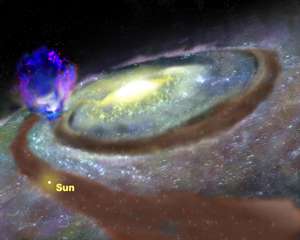
Astronomers using the National Science Foundation's Robert C. Byrd Green Bank Telescope (GBT) in West Virginia have discovered a huge "superbubble" of hydrogen gas rising nearly 10,000 light-years above the plane of our Milky Way Galaxy. They believe the gas may be driven by supernova explosions and the intense stellar winds from an unseen cluster of young stars in one of our Galaxy's spiral arms.
"This giant gas bubble contains about a million times more mass than the Sun, and the energy powering its outflow is equal to about 100 supernova explosions," said Ohio University doctoral candidate Yurii Pidopryhora, who is conducting work for his thesis at the National Radio Astronomy Observatory (NRAO). Pidopryhora, Jay Lockman of NRAO, and Joseph Shields, professor of physics and astronomy at Ohio University, presented their findings at the annual American Astronomical Society meeting today in Washington, D.C.
The superbubble is nearly 23,000 light-years from Earth. The astronomers discovered it by combining numerous smaller images made with the GBT into one large image. In addition, they added images of ionized hydrogen in the region that were made by a University of Wisconsin optical telescope on Kitt Peak in Arizona.
"We see that all the hydrogen gas in this region of the Galaxy is disturbed, with many smaller outflows closer to the plane of the Galaxy and then a giant plume of gas that forms a sort of cap on the whole thing," Pidropryhora said. The ionized hydrogen, with atoms violently stripped of their electrons, seems to fill the interior of the superbubble while the neutral hydrogen forms its walls and cap.
Our Milky Way Galaxy, about 100,000 light-years across, somewhat resembles a giant dinner plate, with most of its stars and gas residing in a flat disk. "Gas driven outward from the plane of the Galaxy's disk has been seen many times before, but this superbubble is particularly large," Lockman said. "The eruption that drove this much mass so far out of the plane has to have been unusually violent," he added.
The scientists speculate that the gas may be blown outward by the strong stellar winds and supernova explosions from numerous massive young stars in a cluster. "One theoretical model shows that young stars could power an outflow that matches what we see very closely," Lockman said. According to that model, the superbubble probably is 10 to 30 million years old.
"Finding this superbubble practically in our back yard is quite exciting, because these superbubbles are very important factors in how galaxies evolve," Pidopryhora said.
Superbubbles, powered by supernova explosions and young stellar winds, control the way heavy elements, produced only in the cores of stars, are distributed throughout the galaxy, the scientists said. Those heavy elements are then incorporated into the next generation of stars -- and planets -- to form.
"The formation of our own Sun and planets probably was heavily influenced, if not triggered, by a nearby supernova explosion," Lockman said.
In addition, if the outflow from superbubbles is energetic enough, it could blow the gas into intergalactic space, never to return to the galaxy. "This would shut down the formation of new stars in the galaxy," Pidopryhora explained.
The Green Bank Telescope, dedicated in 2000, is the largest fully-steerable radio telescope in the world, with more than two acres of collecting area in its giant dish. Located within the National Radio Quiet Zone in West Virginia, the GBT provides
extraordinary sensitivity for observing faint radio-emitting objects in the distant Universe. The National Radio Astronomy Observatory is a facility of the National Science Foundation, operated under cooperative agreement by Associated Universities, Inc.
The Ohio University astronomers are part of the Structure of the Universe project, one of three major research priorities at the institution. The project examines areas ranging from the tiniest quarks and protons to the largest phenomenon in space.
Source: Ohio University


