Fossil Galaxy Reveals Clues to Early Universe
January 12, 2006

Fossil Galaxy Reveals Clues to Early Universe

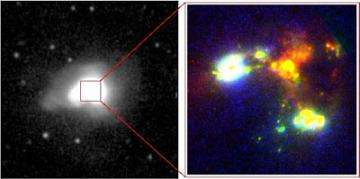
The left hand panel shows a visible light image of Haro 11 acquired at the European Southern Observatories in Chile. North is up and East to the left. The image is 85 arcseconds on the side (114,000 light years at the distance of Haro 11; 1 arcsecond equals 1/3600 degrees). The right hand panel shows a false-color composite of the central part of the galaxy acquired with the Hubble Space Telescope. In this composite, a visible light image from the HST WFPC2 camera is coded in red, an ultraviolet light image from the HST ACS camera is coded in in green, and a spectral line emission image tracing neutral hydrogen (also from HST-ACS), excited by the kind of radiation detected by FUSE, is coded in blue. The ultraviolet light traces hot, young, stars, the visible light traces older, cooler, stars while the the line emission from hydrogen traces the interaction of energetic radiation with the gas in the galaxy. The size of the right hand image is 9.5 x 9.5 arcseconds, which at the distance of Haro 11 corresponds to 12,700 x 12,700 light years. The right hand panel is adapted from the paper by Kunth et al. 2003 in the Astrophysical Journal, Volume 597, page 266, and is reproduced by permission of the AAS.

A tiny galaxy has given astronomers a glimpse of a time when the first bright objects in the universe formed, ending the dark ages that followed the birth of the universe.

Astronomers from Sweden, Spain and the Johns Hopkins University used NASA's Far Ultraviolet Spectroscopic Explorer (FUSE) satellite to make the first direct measurement of ionizing radiation leaking from a dwarf galaxy undergoing a burst of star formation. The result, which has ramifications for understanding how the early universe evolved, will help astronomers determine whether the first stars — or some other type of object — ended the cosmic dark age.

The team will present its results Jan. 12 at the American Astronomical Society's 207th meeting in Washington, D.C.

Considered by many astronomers to be relics from an early stage of the universe, dwarf galaxies are small, very faint galaxies containing a large fraction of gas and relatively few stars. According to one model of galaxy formation, many of these smaller galaxies merged to build up today's larger ones. If that is true, any dwarf galaxies observed now can be thought of as "fossils" that managed to survive — without significant changes — from an earlier period.

Led by Nils Bergvall of the Astronomical Observatory in Uppsala, Sweden, the team observed a small galaxy, known as Haro 11, which is located about 281 million light years away in the southern constellation of Sculptor. The team's analysis of FUSE data produced an important result: between 4 percent and 10 percent of the ionizing radiation produced by the hot stars in Haro 11 is able to escape into intergalactic space.

Ionization is the process by which atoms and molecules are stripped of electrons and converted to positively charged ions. The history of the ionization level is important to understanding the evolution of structures in the early universe, because it determines how easily stars and galaxies can form, according to B-G Andersson, a research scientist in the Henry A. Rowland Department of Physics and Astronomy at Johns Hopkins, and a member of the FUSE team.

"The more ionized a gas becomes, the less efficiently it can cool. The cooling rate in turn controls the ability of the gas to form denser structures, such as stars and galaxies," Andersson said. The hotter the gas, the less likely it is for structures to form, he said.

The ionization history of the universe therefore reveals when the first luminous objects formed, and when the first stars began to shine.

The Big Bang occurred about 13.7 billion years ago. At that time, the infant universe was too hot for light to shine. Matter was completely ionized: atoms were broken up into electrons and atomic nuclei, which scatter light like fog. As it expanded and then cooled, matter combined into neutral atoms of some of the lightest elements. The imprint of this transition today is seen as cosmic microwave background radiation.

The present universe is, however, predominantly ionized; astronomers generally agree that this reionization occurred between 12.5 and 13 billion years ago, when the first large-scale galaxies and galaxy clusters were forming. The details of this ionization are still unclear, but are of intense interest to astronomers studying these so-called "dark ages" of the universe.

Astronomers are unsure if the first stars or some other type of object ended those dark ages, but FUSE observations of "Haro 11" provide a clue.

The observations also help increase understanding of how the universe became reionized. According to the team, likely contributors include the intense radiation generated as matter fell into black holes that formed what we now see as quasars and the leakage of radiation from regions of early star formation. But until now, direct evidence for the viability of the latter mechanism has not been available.

"This is the latest example where the FUSE observation of a relatively nearby object holds important ramifications for cosmological questions," said Dr. George Sonneborn, NASA/FUSE Project Scientist at NASA's Goddard Space Flight Center, Greenbelt, Md.

This result has been accepted for publication by the European journal Astronomy and Astrophysics.

Source: Johns Hopkins University

4.5 /5 (2 votes)  

Rank 4.5 /5 (2 votes)
Tags

Relevant PhysicsForums posts

More news stories

Land and sea species differ in climate change response: study

(Phys.org) -- Marine and terrestrial species will likely differ in their responses to climate warming, new research by Simon Fraser University and Australia’s University of Tasmania has found.

Space & Earth / Environment

created 7 hours ago | popularity 3.8 / 5 (4) | comments 5 | with audio podcast

Yale study concludes public apathy over climate change unrelated to science literacy

Are members of the public divided about climate change because they don't understand the science behind it? If Americans knew more basic science and were more proficient in technical reasoning, would public consensus match ...

Space & Earth / Environment

created 9 hours ago | popularity 4.8 / 5 (5) | comments 20 | with audio podcast

10 million years needed to recover from mass extinction

It took some 10 million years for Earth to recover from the greatest mass extinction of all time, latest research has revealed.

Space & Earth / Earth Sciences

created 9 hours ago | popularity 4 / 5 (4) | comments 1 | with audio podcast

Sophisticated simulations predict future warming

The chances of our planet being hit by a global warming of 3 degrees Celsius by 2050 is as likely as it being hit by an increase of 1.4 degrees, new research shows. Presented in the journal Nature Geoscience, the British study ...

Space & Earth / Earth Sciences

created May 22, 2012 | popularity 3.8 / 5 (11) | comments 51

Aliens don't want to eat us, says former SETI director

Alien life probably isn’t interested in having us for dinner, enslaving us or laying eggs in our bellies, according to a recent statement by former SETI director Jill Tarter.

Space & Earth / Space Exploration

created May 25, 2012 | popularity 4.4 / 5 (15) | comments 41


Stunning image of smallest possible five-ringed structure

Scientists have created and imaged the smallest possible five-ringed structure – about 100,000 times thinner than a human hair – and you'll probably recognise its shape.

'Unzipped' carbon nanotubes could help energize fuel cells, batteries

Multi-walled carbon nanotubes riddled with defects and impurities on the outside could replace some of the expensive platinum catalysts used in fuel cells and metal-air batteries, according to scientists at ...

Change in developmental timing was crucial in the evolutionary shift from dinosaurs to birds: study

At first glance, it's hard to see how a common house sparrow and a Tyrannosaurus Rex might have anything in common. After all, one is a bird that weighs less than an ounce, and the other is a dinosaur that ...

Computer model used to pinpoint prime materials for efficient carbon capture

When power plants begin capturing their carbon emissions to reduce greenhouse gases – and to most in the electric power industry, it's a question of when, not if – it will be an expensive undertaking.

T cells 'hunt' parasites like animal predators seek prey, study shows

By pairing an intimate knowledge of immune-system function with a deep understanding of statistical physics, a cross-disciplinary team at the University of Pennsylvania has arrived at a surprising finding: T cells use a movement ...

Scientists develop ultra-sensitive test that detects diseases in their earliest stages

Scientists have developed an ultra-sensitive test that should enable them to detect signs of a disease in its earliest stages, in research published today in the journal Nature Materials.