Multi-wavelength images help astronomers study star birth, death
Jan 11, 2006
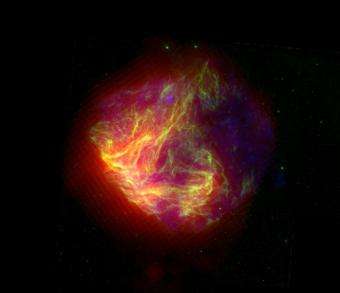
This false-color image shows infrared (red), optical (green), and X-ray (blue) views of the N49 supernova remnant
This false-color image shows infrared (red), optical (green), and X-ray (blue) views of the N49 supernova remnant. This object, the remains of an exploded star, has million-degree gas in the center, with much cooler gas at the outer parts of the remnant. Credit: NASA (SSC/HST/CXC), U.Illinois (R.Williams & Y.-H.Chu)

Black and white reproductions of Vincent van Gogh's "The Starry Night" lack the beauty and depth of the original oil painting. In a similar fashion, images of stars and galaxies composed of a single wavelength band cannot convey the wealth of information now accessible to astronomers.

In recent years, a number of ground-based optical and radio surveys of the Large and Small Magellanic Clouds -- Earth's nearest neighboring galaxies -- have become available. New composite images of optical, radio, infrared, ultraviolet and X-ray wavelengths are giving astronomers at the University of Illinois at Urbana-Champaign a clearer picture of the birth, life and death of massive stars, and their effect on the gas and dust of the interstellar medium surrounding them.
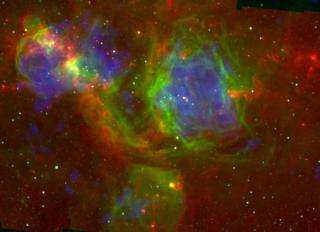
This false-color image shows infrared (red), optical (green), and X-ray (blue) views of the large star-forming complex N51
This false-color image shows infrared (red), optical (green), and X-ray (blue) views of the large star-forming complex N51. The warm ionized gas is shown in green, the hot ionized gas is in blue, and the proto-stars are primarily in red. Credit: NASA/SSC/MCELS/ESA/U.Illinois (Y.-H. Chu and R. A. Gruendl)

From their birth to their death, massive stars have a tremendous impact on their galactic surroundings. While alive, these stars energize and enrich the interstellar medium with their strong ultraviolet radiation and their fast stellar winds. As they die, shock waves from their death throes inject vast quantities of mechanical energy into the interstellar medium and can lead to the formation of future stars.

"Comparing images at different wavelengths lets us create a more complete picture, rather than seeing only a few features in isolation," said You-Hua Chu, chair of the astronomy department at Illinois. "Using multi-spectral data sets, we can examine the physical structure of the interstellar medium and study the conditions that lead to star formation."

Massive stars interact with the interstellar medium in many ways. Their fast stellar winds and supernova blasts can sweep up the surrounding medium into expanding shells filled with hot gas.

"The expanding shells produce conditions that may start a new wave of star births," said Robert Gruendl, an Illinois astronomer who uses Spitzer Space Telescope observations to search for proto-stars. "The combination of X-ray, optical and infrared observations allow us to determine whether the pressure of the hot gas or compression by a passing shock wave is responsible for triggering star formation."

In related work, Illinois astronomer Rosa Williams has added data from a new wavelength regime to her growing database on stellar graveyards in the Magellanic Clouds. Comparing infrared images obtained with the Spitzer Space Telescope, Williams explored the distribution of matter caught in the expanding shells of supernova remnants.

"We expected significant infrared emission to be generated by dust particles," Williams said. "Instead, most of the emission from these remnants came from heated gas."

Strong ultraviolet radiation from nearby star-forming regions may have ionized the gas and torn apart the dust particles consisting of hydrocarbon molecules, Williams said. "Other dust particles could have been shattered by shock waves from the supernova."

To solve the missing dust mystery, Williams said, "We are investigating the nature and amount of dust in regions surrounding the supernova remnants to see whether the deficiency in dust is inherent in the environment or created by the remnant."

Chu, Gruendl and Williams will present their latest findings at the American Astronomical Society meeting in Washington, D.C., on Wednesday (Jan. 11).

Source: University of Illinois at Urbana-Champaign

Explore further: Communications satellite launched into space

add to favorites email to friend print save as pdf

Related Stories

A disturbed galactic duo

Apr 20, 2011

(PhysOrg.com) -- The galaxies in this cosmic pairing, captured by the Wide Field Imager on the MPG/ESO 2.2-metre telescope at the La Silla Observatory in Chile, display some curious features, demonstrating ...

Possible missing link between young and old galaxies

Jan 10, 2011

University of California, Berkeley, astronomers may have found the missing link between gas-filled, star-forming galaxies and older, gas-depleted galaxies typically characterized as "red and dead."

Exploring the Carina Nebula By Touch

Mar 30, 2010

(PhysOrg.com) -- The Hubble Space Telescope's dramatic glimpse of the Carina Nebula, a gigantic cloud of dust and gas bustling with star-making activity, is a glorious feast for the eyes. Energetic young stars ...

NGC 4710 galaxy: Baffling boxy bulge (w/ Video)

Nov 18, 2009

(PhysOrg.com) -- Just as many people are surprised to find themselves packing on unexplained weight around the middle, astronomers find the evolution of bulges in the centres of spiral galaxies puzzling. A ...

Herschel first images promise bright future

Jul 10, 2009

Herschel has carried out the first test observations with all its instruments, with spectacular results. Galaxies, star-forming regions and dying stars comprised the telescope's first targets. The instruments ...

Recommended for you

Galaxies fed by funnels of fuel

May 24, 2013

(Phys.org) —Computer simulations of galaxies growing over billions of years have revealed a likely scenario for how they feed: a cosmic version of swirly straws.

Dark, massive asteroid to fly by Earth on May 31

May 24, 2013

It's 1.7 miles long. Its surface is covered in a sticky black substance similar to the gunk at the bottom of a barbecue. If it impacted Earth it would probably result in global extinction. Good thing it is ...

Source of life running out: water scientists

May 24, 2013

The majority of people on Earth people will face severe water shortages within a generation or two if pollution and waste continues unabated, scientists warned at a conference in Bonn Friday.

Research team explains 'Lazarus' comets

May 24, 2013

Astronomers from the University of Antioquia have discovered a graveyard of comets. These once-dormant comets, dubbed by astronomers as "The Lazarus comets," are now rejuvenated.

User comments : 0

More news stories

Galaxies fed by funnels of fuel

(Phys.org) —Computer simulations of galaxies growing over billions of years have revealed a likely scenario for how they feed: a cosmic version of swirly straws.

Yahoo, pay-TV operators among Hulu bidders

Online video site Hulu is again up for sale, with Yahoo and pay TV operators DirecTV and Time Warner Cable among the seven bidders, according to a person with direct knowledge of the matter.