Researchers find plant protein that may aid biofuel production
Apr 27, 2007
Plant Enzymes
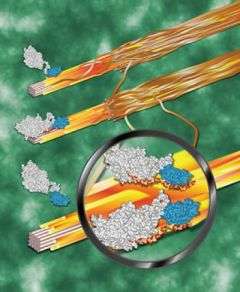
This schematic diagram shows the newly discovered class of plant enzymes with a cellulose-binding module (shown in blue), sticking to a plant cell wall. The binding module of the enzyme helps the catalytic region of the enzyme (shown in more detail in gray in the pullout part of the picture) break down the crystalline cellulose. Credit: Daniel Ripoll and Chris Pelkie/Cornell Theory Center

In a breakthrough that could make the production of cellulosic ethanol less expensive, Cornell researchers have discovered a class of plant enzymes that potentially could allow plant materials used to make ethanol to be broken down more efficiently than is possible using current technologies.

There is a growing recognition that corn ethanol is unlikely to provide a long-term solution, or one that is environmentally sustainable, and so scientists are turning to cellulose as an alternative.

Production of ethanol from cellulose in mass quantities that are priced competitively with corn-based ethanol has not yet been possible. And without the cellulosic ethanol, the national goal for ethanol production to reduce oil imports will be impossible to reach, experts say.

A critical step in producing cellulosic ethanol involves breaking down a plant's cell wall material and fermenting the sugars that are released. Current technologies use microbial enzymes called "cellulases" to digest the cellulose in grasses and such rapidly growing trees as poplars. The microbial enzymes have a structure that makes them very efficient at binding to and digesting plant cell wall material called lignocellulose (a combination of lignin and cellulose).

But now, a new class of plant enzymes with a similar structure has been discovered, potentially offering researchers new properties for producing ethanol even more efficiently.

"The bottleneck for conversion of lignocellulose into ethanol is efficient cellulose degradation," said Jocelyn Rose, Cornell assistant professor of plant biology. "The discovery of these enzymes suggests there might be sets of new plant enzymes to improve the efficiency of cellulose degradation."

The paper appears in the April 20 issue of the Journal of Biological Chemistry. Breeanna Urbanowicz, a graduate student in Rose's laboratory, was the paper's lead author.

For an enzyme to break down cellulose, a structure called a cellulose-binding module attaches to the cellulose. Once attached, a catalyst then breaks the polymer into small units, which can then be turned into ethanol. While researchers have known that plants have cellulaselike enzymes, it was previously thought that they did not have a cellulose-binding module, and so could not attach to cellulose or digest it very effectively -- until now.

"This is the first example of a cellulose-binding domain in a plant cell wall enzyme," said Rose.

While the new enzyme was found in a tomato plant, Rose and colleagues have evidence of a set of such plant proteins in many species that potentially could be used for biofuel production. Biofuel research may also help uncover exciting new uses for these enzymes, said Rose. Researchers may, for example, breed for plants with high levels of these proteins.

Though the scientists stress that more study is needed to understand how plants use this class of enzymes, Rose speculates that they may be needed when growing tissues rapidly expand and require loosening of tightly bound strands of cellulose, called microfibrils, that make up a cell wall's structure. The binding enzymes may also be part of the process of breaking down tissues, e.g., when fruits -- such as tomatoes -- soften.

Source: Cornell University

Explore further: Making ice-cream more nutritious with meat left-overs

add to favorites email to friend print save as pdf

Related Stories

Team creates potential food source from non-food plants

Apr 16, 2013

A team of Virginia Tech researchers has succeeded in transforming cellulose into starch, a process that has the potential to provide a previously untapped nutrient source from plants not traditionally thought ...

Biomass analysis tool is faster, more precise

Mar 05, 2013

A screening tool from the U.S. Department of Energy's National Renewable Energy Laboratory (NREL) eases and greatly quickens one of the thorniest tasks in the biofuels industry: determining cell wall chemistry to find plants ...

New protein probes find enzymes for biofuel production

Feb 06, 2013

New protein probes are now helping scientists find the best biomass-to-biofuel production enzymes that nature has to offer. Turning biomass into biofuel hinges on the breakdown of the energy-rich primary ...

Virdia gets $100 million to start cellulose ethanol plant

Mar 09, 2012

(PhysOrg.com) -- Despite calls for finding alternatives to using corn to make biofuel, the United States currently has no such commercial biomass-to-sugar processing plants able to do so. That may soon change ...

Recommended for you

Making ice-cream more nutritious with meat left-overs

4 hours ago

Food industries are now turning meat left-over into high-protein content ingredients for food supplements, or to be added to processed food. But a EU-wide regulation covering them is still lacking.

Non-wetting fabric drains sweat

19 hours ago

(Phys.org) —Waterproof fabrics that whisk away sweat could be the latest application of microfluidic technology developed by bioengineers at the University of California, Davis.

Protein study suggests drug side effects are inevitable

21 hours ago

A new study of both computer-created and natural proteins suggests that the number of unique pockets – sites where small molecule pharmaceutical compounds can bind to proteins – is surprisingly small, meaning drug side ...

Attacking MRSA with metals from antibacterial clays

May 17, 2013

In the race to protect society from infectious microbes, the bugs are outrunning us. The need for new therapeutic agents is acute, given the emergence of novel pathogens as well as old foes bearing heightened antibiotic resistance.

User comments : 0

More news stories

Protein study suggests drug side effects are inevitable

A new study of both computer-created and natural proteins suggests that the number of unique pockets – sites where small molecule pharmaceutical compounds can bind to proteins – is surprisingly small, meaning drug side ...

Non-wetting fabric drains sweat

(Phys.org) —Waterproof fabrics that whisk away sweat could be the latest application of microfluidic technology developed by bioengineers at the University of California, Davis.

Beautiful 'flowers' self-assemble in a beaker

By simply manipulating chemical gradients in a beaker of fluid, materials scientists at Harvard have found that they can control the growth behavior of crystals to create precisely tailored structures—such ...

Attacking MRSA with metals from antibacterial clays

In the race to protect society from infectious microbes, the bugs are outrunning us. The need for new therapeutic agents is acute, given the emergence of novel pathogens as well as old foes bearing heightened antibiotic resistance.

If you can remember it, you can remember it wrong

(Medical Xpress)—Native peoples in regions where cameras are uncommon sometimes react with caution when their picture is taken. The fear that something must have been stolen from them to create the photo ...