Fourteen Times the Earth - Smallest Ever Extra-Solar Planet Discovered
A European team of astronomers has discovered the lightest known planet orbiting a star other than the sun (an "exoplanet"). The new exoplanet orbits the bright star mu Arae located in the southern constellation of the Altar. It is the second planet discovered around this star and completes a full revolution in 9.5 days. With a mass of only 14 times the mass of the Earth, the new planet lies at the threshold of the largest possible rocky planets, making it a possible super Earth-like object. Uranus, the smallest of the giant planets of the Solar System has a similar mass. However Uranus and the new exoplanet differ so much by their distance from the host star that their formation and structure are likely to be very different.
This discovery was made possible by the unprecedented accuracy of the HARPS spectrograph on ESO's 3.6-m telescope at La Silla, which allows radial velocities to be measured with a precision better than 1 m/s. It is another clear demonstration of the European leadership in the field of exoplanet research.
A unique planet hunting machine
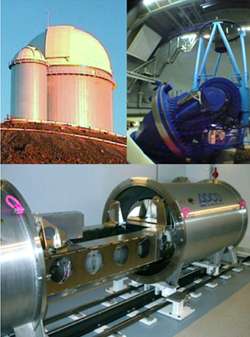
The continued quest for exoplanets requires better and better instrumentation. In this context, ESO undoubtedly took the leadership with the new HARPS spectrograph (High Accuracy Radial Velocity Planet Searcher) of the 3.6-m telescope at the ESO La Silla Observatory. Offered in October 2003 to the research community in the ESO member countries, this unique instrument is optimized to detect planets in orbit around other stars ("exoplanets") by means of accurate (radial) velocity measurements with an unequalled precision of 1 metre per second.
HARPS was built by a European Consortium in collaboration with ESO. Already from the beginning of its operation, it has demonstrated its very high efficiency. By comparison with CORALIE, another well known planet-hunting optimized spectrograph installed on the Swiss-Euler 1.2-m telescope at La Silla, the typical observation times have been reduced by a factor one hundred and the accuracy of the measurements has been increased by a factor ten.
These improvements have opened new perspectives in the search for extra-solar planets and have set new standards in terms of instrumental precision.
Mu Arae planetary system
The star mu Arae is about 50 light years away. This solar-like star is located in the southern constellation Ara (the Altar) and is bright enough (5th magnitude) to be observed with the unaided eye.
Mu Arae was already known to harbour a Jupiter-sized planet with a 650 days orbital period. Previous observations also hinted at the presence of another companion (a planet or a star) much further away.
The new measurements obtained by the astronomers on this object, combined with data from other teams confirm this picture. But as François Bouchy, member of the team, states: "Not only did the new HARPS measurements confirm what we previously believed to know about this star but they also showed that an additional planet on short orbit was present. And this new planet appears to be the smallest yet discovered around a star other than the sun. This makes mu Arae a very exciting planetary system."
New planet
The mass of this planet places it at the boundary between the very large earth-like (rocky) planets and giant planets.
As current planetary formation models are still far from being able to account for all the amazing diversity observed amongst the extrasolar planets discovered, astronomers can only speculate on the true nature of the present object. In the current paradigm of giant planet formation, a core is formed first through the accretion of solid "planetesimals". Once this core reaches a critical mass, gas accumulates in a "runaway" fashion and the mass of the planet increases rapidly. In the present case, this later phase is unlikely to have happened for otherwise the planet would have become much more massive. Furthermore, recent models having shown that migration shortens the formation time, it is unlikely that the present object has migrated over large distances and remained of such small mass.
This object is therefore likely to be a planet with a rocky (not an icy) core surrounded by a small (of the order of a tenth of the total mass) gaseous envelope and would therefore qualify as a "super-Earth".
This research described in this release has been submitted for publication to the leading astrophysical journal "Astronomy and Astrophysics". A preprint is available as a postscript file at www.oal.ul.pt/~nuno/


