Want to monitor climate change? P-p-p-pick up a penguin!
Apr 04, 2007
King Penguin
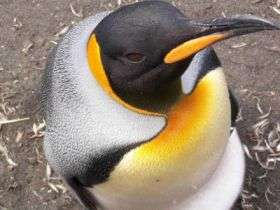
King penguin. Credit: Lewis Halsey

We are used to hearing about the effects of climate change in terms of unusual animal behaviour, such as altering patterns of fish and bird migration. However, scientists at the University of Birmingham are trying out an alternative bio-indicator – the king penguin – to investigate whether they can be used to monitor the effects of climate change.

“If penguins are travelling further or diving deeper for food, that tells us something about the availability of particular fish in regions of the Antarctic. We may be able to assess the pressure exerted by king penguins on this ecosystem, and look at the effects of both climate change and overfishing in this region of the world”, says Dr Lewis Halsey who will present his results on Wednesday 4th April at the Society for Experimental Biology’s Annual Meeting in Glasgow.

A new way of using animals as bio-indicators is to ascertain their energy requirements. Dr Halsey and co-workers measured the heart rate and energy expenditure of king penguins whilst walking on a treadmill and whilst swimming in a long water channel, and obtained relationships between these two variables. They then implanted heart rate loggers in penguins going to sea such that they could infer the energy expended by these birds from the recorded heart rate. Researchers were then able to find out if there was a correlation between the energetic costs of foraging at sea and the levels of fish available to the penguins i.e. did penguins have to work harder when food was scarce.

King penguins are good candidates as bio-indicators for several reasons. Firstly, while at sea foraging, they cover hundreds of kilometres and are able to dive to depths of several hundred metres, so they explore a relatively large portion of the expansive Southern Oceans. Secondly, the diets of several populations of king penguins are well known. Thirdly, while foraging for food is done at sea the penguins also come ashore to breed and moult, making them accessible to researchers.

Source: Society for Experimental Biology

Explore further: Biological fitness trumps other traits in mating game

add to favorites email to friend print save as pdf

Related Stories

Snowden's life surrounded by spycraft

6 hours ago

In the suburbs edged by woods midway between Baltimore and the U.S. capital, residents long joked that the government spy shop next door was so ultra-secretive its initials stood for "No Such Agency." But ...

Winners and losers at this week's E3

6 hours ago

Since the first battles over "Pong" machines in local arcades four decades ago, video gamers have loved good competition. And this year's Electronic Entertainment Expo—the industry's largest annual gathering—presented ...

Europe's space truck docks with ISS

6 hours ago

A robot freighter bearing 6.6 tonnes of cargo docked with the International Space Station (ISS) on Saturday, the European Space Agency (ESA) said.

Secret to Prism program: Even bigger data seizure

6 hours ago

In the months and early years after the Sept. 11, 2001, terrorist attacks, FBI agents began showing up at Microsoft Corp. more frequently than before, armed with court orders demanding information on customers.

Recommended for you

Biological fitness trumps other traits in mating game

2 hours ago

When a new species emerges following adaptive changes to its local environment, the process of choosing a mate can help protect the new species' genetic identity and increase the likelihood of its survival. ...

Snail genetic tracks reveal ancient human migration

3 hours ago

Some snails in Ireland and the Pyrenees are genetically almost identical, perhaps because they were carried across the Atlantic during an 8000-year-old human migration. The snail genetics tie in with studies ...

World Food Prize goes to 3 biotech scientists

6 hours ago

This year's World Food Prize is going to a Belgian scientist and two researchers in the United States for their innovations that brought the world genetically modified crops.

User comments : 0

More news stories

Snail genetic tracks reveal ancient human migration

Some snails in Ireland and the Pyrenees are genetically almost identical, perhaps because they were carried across the Atlantic during an 8000-year-old human migration. The snail genetics tie in with studies ...