Man's earliest direct ancestors looked more apelike than previously believed
Mar 25, 2007
Man's earliest direct ancestors looked more apelike than previously believed
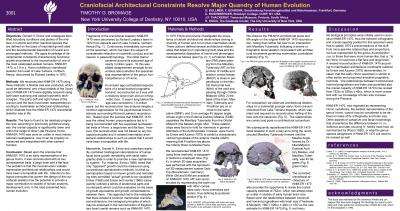
IADR 2007 Conference Poster Dr. Timothy G. Bromage, New York University College of Dentistry, NY 10010, USA. Credit: Timothy G. Bromage

Modern man"s earliest known close ancestor was significantly more apelike than previously believed, a New York University College of Dentistry professor has found.

A computer-generated reconstruction by Dr. Timothy Bromage, a paleoanthropologist and Adjunct Professor of Biomaterials and of Basic Science and Craniofacial Biology, shows a 1.9 million-year-old skull belonging to Homo rudolfensis, the earliest member of the human genus, with a surprisingly small brain and distinctly protruding jaw, features commonly associated with more apelike members of the hominid family living as much as three million years ago.

Dr. Bromage"s findings call into question the extent to which H. rudolfensis differed from earlier, more apelike hominid species. Specifically, he is the first scientist to produce a reconstruction of the skull that questions renowned paleontologist and archeologist Richard Leakey"s depiction of modern man"s earliest direct ancestor as having a vertical facial profile and a relatively large brain – an interpretation widely accepted until now.

Dr. Bromage"s reconstruction also suggests that humans developed a larger brain and more vertical face with a less pronounced jaw and smaller teeth at least 300,000 years later than commonly believed, perhaps as recently as 1.6 million to one million years ago, when two later species, H. ergaster and H. erectus, lived. Dr. Bromage presented his findings today at the annual scientific session of the International Association for Dental Research in New Orleans.

The fragmented skull Dr. Bromage reconstructed was originally discovered in Kenya in 1972 by Dr. Leakey, who reassembled it by hand and dated it at nearly three million years of age, an estimate revised to 1.9 million years by scientists who later discovered problems with the dating.

"Dr. Leakey produced a biased reconstruction based on erroneous preconceived expectations of early human appearance that violated principles of craniofacial development," said Dr. Bromage, whose reconstruction, by contrast, shows a sharply protruding jaw and a brain less than half the size of a modern human"s. These characteristics make the 1.9 million-year-old early human skull more like those of two archaic, apelike hominids, Australopithecus and early Paranthropus, living at least three million and 2.5 million years ago, respectively.

Dr. Bromage developed his reconstruction according to biological principles holding that the eyes, ears, and mouth must be in precise relationship to one another in all mammals.

"Because he did not employ such principles, Dr. Leakey produced a reconstruction that could not have existed in real life," Dr. Bromage concluded.

Source: New York University

Explore further: Scientists present new insights on climate change and species interactions

add to favorites email to friend print save as pdf

Related Stories

NASA's BARREL mission launches 20 balloons

3 hours ago

(Phys.org) —In Antarctica in January, 2013 – the summer at the South Pole – scientists released 20 balloons, each eight stories tall, into the air to help answer an enduring space weather question: ...

Amazon plans greenhouse-style headquarters

3 hours ago

US online giant Amazon has unveiled plans for a futuristic greenhouse style headquarters "where employees can work and socialize in a more natural, park-like setting."

With high-tech guns, users could disable remotely

3 hours ago

A high-tech startup is wading into the gun control debate with a cellphone controller that would allow gun owners to know when their weapon is being moved—and disable it remotely.

Recommended for you

New DNA cattle test beefs up dairy and meat quality

4 minutes ago

(Phys.org) —A genomics technique developed at Cornell to improve corn can now be used to improve the quality of milk and meat, according to research published online May 17 in the journal PLOS ONE.

Strawberry fields forever and fungus-free

12 minutes ago

(Phys.org) —Strawberries are one of the most economically important berry crops in the world, and a high value export crop for the Australian horticultural industry.For the first time, researchers at The ...

Coral reefs 'ruled by earthquakes and volcanoes'

44 minutes ago

(Phys.org) —Titanic forces in the Earth's crust explain why the abundance and richness of corals varies dramatically across the vast expanse of the Indian and Pacific Oceans, a world-first study from the ...

Wound healing: 'See-saw' switch sends cells on the march

54 minutes ago

Many genes are transcribed into messenger RNA (mRNA) molecules that provide instructions for protein synthesis. Other genes encode regulatory RNAs known as 'microRNAs', which can block protein translation ...

Coccoliths thrive despite ocean acidification

1 hour ago

Ocean acidification is damaging some marine species while others thrive, say scientists. An international team studied the effect of ocean acidification on plankton in the North Sea over the past forty years, ...

User comments : 0

More news stories

Coral reefs 'ruled by earthquakes and volcanoes'

(Phys.org) —Titanic forces in the Earth's crust explain why the abundance and richness of corals varies dramatically across the vast expanse of the Indian and Pacific Oceans, a world-first study from the ...

100K Pathogen Genome Project maps first genomes

(Phys.org) —Striking a blow at foodborne diseases, the 100K Pathogen Genome Project at the University of California, Davis, today announced that it has sequenced the genomes of its first 10 infectious microorganisms, including ...

Strawberry fields forever and fungus-free

(Phys.org) —Strawberries are one of the most economically important berry crops in the world, and a high value export crop for the Australian horticultural industry.For the first time, researchers at The ...

Theorists weigh in on where to hunt dark matter

(Phys.org) —Now that it looks like the hunt for the Higgs boson is over, particles of dark matter are at the top of the physics "Most Wanted" list. Dozens of experiments have been searching for them, but ...