Neighbors gone, fruits gone, species gone
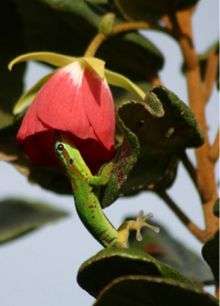
Neighbors gone, sex gone, fruits gone, species gone. This is the ultra-short conclusion of the findings in a study by Dennis Hansen, Heine Kiesbüy, and Christine Müller from Zurich University, and Carl Jones from the Mauritian Wildlife Foundation, who found that an endangered plant in Mauritius depends on a neighboring plant to provide a safe home for its pollinator, a day-active gecko.
Trochetia blackburniana, a rare endemic Mauritian plant, produces large red flowers, that are pollinated by the endemic day gecko Phelsuma cepediana. Day geckos of the genus Phelsuma are inquisitive animals. However, they cannot move around freely all the time, if they want to avoid predators. Thus, the geckos spend a lot of time hiding. A favorite hideout of Phelsuma cepediana is the maze of spiky leaves offered by dense patches of Pandanus plants.
In an experiment carried out in 2003 and 2004 and reported in the April issue of the American Naturalist, Hansen and coworkers could show that Trochetia plants growing close to Pandanus patches had a higher chance of being pollinated and produce fruit than plants further away. Thus, Trochetia enters an indirect dependency with its neighbor Pandanus via the geckos.
"The case of Trochetia and its pollinator is only one of many examples of the complexity and fragility of island community interactions. When an island ecosystem is altered by humans, the outcome for both plants and animals are hard to predict. We need field experiments such as this one to understand the potentially disastrous effects," says Christine Müller. "There has been a long tradition of studying direct interactions in pollination biology," says Dennis Hansen, "but only little focus on indirect interactions, even though they often have large effects. Our study illustrates how important it is to know as much as possible about the community-level interactions of an endangered species before deciding on conservation management. Who would have thought that to conserve Trochetia blackburniana we would end up saying 'plant more patches of Pandanus'?"
Citation: Dennis M. Hansen, Heine C. Kiesbüy, Carl G. Jones, and Christine B. Müller, "Positive indirect interactions between neighbouring plant species via a lizard pollinator" The American Naturalist, volume 169 (2007), pages 534–542
Source: University of Chicago


