NASA Prepares for Return of Interstellar Cargo
December 21, 2005

NASA Prepares for Return of Interstellar Cargo

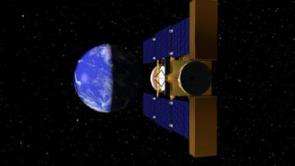
NASA's Stardust mission is nearing Earth after a 2.88 billion mile round-trip journey to return cometary and interstellar dust particles back to Earth. Scientists believe the cargo will help provide answers to fundamental questions about comets and the origins of the solar system.

The velocity of the sample return capsule, as it enters the Earth's atmosphere at 28,860 mph, will be the fastest of any human-made object on record. It surpasses the record set in May 1969 during the return of the Apollo 10 command module. The capsule is scheduled to return on Jan. 15.

"Comets are some of the most informative occupants of the solar system. The more we can learn from science exploration missions like Stardust, the more we can prepare for human exploration to the moon, Mars and beyond," said Mary Cleave, associate administrator for NASA's Science Mission Directorate.

Several events must occur before scientists can retrieve cosmic samples from the capsule landing at the U.S. Air Force Utah Test and Training Range, southwest of Salt Lake City. Mission navigators will command the spacecraft to perform targeting maneuvers on Jan. 5 and 13. On Jan. 15 at 12:57 a.m. EST, Stardust will release its sample return capsule. Four hours later, the capsule will enter Earth's atmosphere 410,000 feet over the Pacific Ocean.

The capsule will release a drogue parachute at approximately 105,000 feet. Once the capsule has descended to about 10,000 feet, the main parachute will deploy. The capsule is scheduled to land on the range at 5:12 a.m. EST.

After the capsule lands, if conditions allow, a helicopter crew will fly it to the U.S. Army Dugway Proving Ground, Utah, for initial processing. If weather does not allow helicopters to fly, special off-road vehicles will retrieve the capsule and return it to Dugway. Samples will be moved to a special laboratory at NASA's Johnson Space Center, Houston, where they will be preserved and studied.

"Locked within the cometary particles is unique chemical and physical information that could be the record of the formation of the planets and the materials from which they were made," said Don Brownlee, Stardust principal investigator at the University of Washington, Seattle.

NASA expects most of the collected particles to be no more than a third of a millimeter across. Scientists will slice these particle samples into even smaller pieces for study.

The Jet Propulsion Laboratory, Pasadena, Calif. manages the Stardust mission for NASA's Science Mission Directorate, Washington. Lockheed Martin Space Systems, Denver, developed and operates the spacecraft.

For information about the Stardust mission on the Web, visit:
http://www.nasa.gov/stardust

Source: NASA


Rank not rated yet
Tags

Relevant PhysicsForums posts

More news stories

Land and sea species differ in climate change response: study

(Phys.org) -- Marine and terrestrial species will likely differ in their responses to climate warming, new research by Simon Fraser University and Australia’s University of Tasmania has found.

Space & Earth / Environment

created 8 hours ago | popularity 4 / 5 (5) | comments 6 | with audio podcast

Yale study concludes public apathy over climate change unrelated to science literacy

Are members of the public divided about climate change because they don't understand the science behind it? If Americans knew more basic science and were more proficient in technical reasoning, would public consensus match ...

Space & Earth / Environment

created 10 hours ago | popularity 4.8 / 5 (6) | comments 26 | with audio podcast

10 million years needed to recover from mass extinction

It took some 10 million years for Earth to recover from the greatest mass extinction of all time, latest research has revealed.

Space & Earth / Earth Sciences

created 10 hours ago | popularity 4.2 / 5 (5) | comments 2 | with audio podcast

Sophisticated simulations predict future warming

The chances of our planet being hit by a global warming of 3 degrees Celsius by 2050 is as likely as it being hit by an increase of 1.4 degrees, new research shows. Presented in the journal Nature Geoscience, the British study ...

Space & Earth / Earth Sciences

created May 22, 2012 | popularity 3.8 / 5 (11) | comments 51

Aliens don't want to eat us, says former SETI director

Alien life probably isn’t interested in having us for dinner, enslaving us or laying eggs in our bellies, according to a recent statement by former SETI director Jill Tarter.

Space & Earth / Space Exploration

created May 25, 2012 | popularity 4.4 / 5 (15) | comments 41


'Unzipped' carbon nanotubes could help energize fuel cells, batteries

Multi-walled carbon nanotubes riddled with defects and impurities on the outside could replace some of the expensive platinum catalysts used in fuel cells and metal-air batteries, according to scientists at ...

Change in developmental timing was crucial in the evolutionary shift from dinosaurs to birds: study

At first glance, it's hard to see how a common house sparrow and a Tyrannosaurus Rex might have anything in common. After all, one is a bird that weighs less than an ounce, and the other is a dinosaur that ...

Computer model used to pinpoint prime materials for efficient carbon capture

When power plants begin capturing their carbon emissions to reduce greenhouse gases – and to most in the electric power industry, it's a question of when, not if – it will be an expensive undertaking.

T cells 'hunt' parasites like animal predators seek prey, study shows

By pairing an intimate knowledge of immune-system function with a deep understanding of statistical physics, a cross-disciplinary team at the University of Pennsylvania has arrived at a surprising finding: T cells use a movement ...

Stunning image of smallest possible five-ringed structure

Scientists have created and imaged the smallest possible five-ringed structure – about 100,000 times thinner than a human hair – and you'll probably recognise its shape.

Browser wars flare in mobile space

The browser wars are heating up again, but this time the fight is for dominance of the mobile Internet.