Researchers extend Einstein's work
Dec 20, 2005
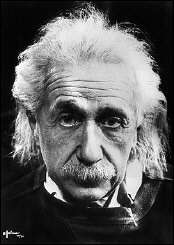
Albert Einstein

A University of Queensland research team has celebrated the end of the Einstein International Year of Physics by developing a ground-breaking theory based on work originated by the great scientist.

The theory was developed by physicists Dr Karen Kheruntsyan, Dr Murray Olsen and Professor Peter Drummond at the UQ node of the Australian Research Council Centre of Excellence for Quantum-Atom Optics (ACQAO).

Dr Kheruntsyan said the world-first theory combined two of Einstein's many outstanding contributions to science – the Einstein-Podolsky-Rosen (EPR) paradox and Bose-Einstein condensation.

“The original EPR work was undertaken by Albert Einstein in the 1930s and questioned the basis of what is today known as quantum mechanics,” Dr Kheruntsyan said.

“Einstein was never happy with certain aspects of quantum mechanics and the EPR paradox has been one of the most puzzling physics problems for the past 80 years. The essence of the paradox is that it suggested that classical concepts of physical reality were not applicable in the quantum domain.

“The new work represents a break-through in this area of theoretical science and could have major applications in many areas, particularly new gravity sensors.”

Dr Kheruntsyan said the theory extended pioneering work carried out by Reid and Drummond in the late 1980s, which demonstrated how to perform the famous EPR thought experiments using photons (light).

“The new technology of Bose-Einstein condensates and atom lasers available today has enabled us to extend this work even further and we have now been able to propose a demonstration of the EPR paradox using ultra-cold atoms.

“Unlike the earlier work with photons, atoms feel the force of gravity and these new techniques will open up a whole new field for testing quantum mechanics in future,” Dr Kheruntsyan said.

A paper on the new theory “Einstein-Podolsky-Rosen correlations via dissociation of a molecular Bose-Einstein condensate” was published in the October issue of the world's most prestigious journal, the Physics Review Letters.

ACQAO undertakes research which is carried out at three Australian universities: The University of Queensland, the Australian National University and Swinburne University of Technology.

See also: phys.org/news139.html

Source: University of Queensland

Explore further: Iron-platinum alloys could be new-generation hard drives

add to favorites email to friend print save as pdf

Related Stories

Recommended for you

Lab sets a new record for creating heralded photons

12 hours ago

(Phys.org) —Entanglement, by general consensus of physicists, is the weirdest part of quantum science. To say that two particles, A and B, are entangled means that they are actually two parts of an inseparable ...

Breakthrough calls time on bootleg booze

18 hours ago

(Phys.org) —Using a laser, the St Andrews scientists can now carry out detailed analysis of a spirit sample no bigger than a teardrop and can even confirm whether it is toxic or not. It's hoped the testing ...

Competition in the quantum world

22 hours ago

Innsbruck physicists led by Rainer Blatt and Peter Zoller experimentally gained a deep insight into the nature of quantum mechanical phase transitions. They are the first scientists that simulated the competition ...

Promising doped zirconia

May 17, 2013

Materials belonging to the family of dilute magnetic oxides (DMOs)—an oxide-based variant of the dilute magnetic semiconductors—are good candidates for spintronics applications. This is the object of ...

User comments : 0

More news stories

Lab sets a new record for creating heralded photons

(Phys.org) —Entanglement, by general consensus of physicists, is the weirdest part of quantum science. To say that two particles, A and B, are entangled means that they are actually two parts of an inseparable ...

Competition in the quantum world

Innsbruck physicists led by Rainer Blatt and Peter Zoller experimentally gained a deep insight into the nature of quantum mechanical phase transitions. They are the first scientists that simulated the competition ...

Breakthrough calls time on bootleg booze

(Phys.org) —Using a laser, the St Andrews scientists can now carry out detailed analysis of a spirit sample no bigger than a teardrop and can even confirm whether it is toxic or not. It's hoped the testing ...

New principle may help explain why nature is quantum

Like small children, scientists are always asking the question 'why?'. One question they've yet to answer is why nature picked quantum physics, in all its weird glory, as a sensible way to behave. Researchers ...

Child maltreatment increases risk of adult obesity

Children who have suffered maltreatment are 36% more likely to be obese in adulthood compared to non-maltreated children, according to a new study by King's College London. The authors estimate that the prevention or effective ...

New immune system discovered

(Medical Xpress)—A research team, led by Jeremy Barr, a biology post-doctoral fellow, unveils a new immune system that protects humans and animals from infection.