Researchers Create New Method for Uncovering Natural Products from Mystery ‘Orphan Genes’
Microorganisms have a proven track record for producing powerful molecules useful in antibiotics, as anticancer agents, and in treating human diseases.
At times, researchers studying the genomes of these microorganisms have come across sections of DNA for which scientists cannot determine what is ultimately produced. It’s not clear what might be created from these so-called “orphan gene clusters” and if those end products might carry beneficial qualities.
Scientists at Scripps Institution of Oceanography at UC San Diego have devised a new method for identifying the mysterious products of orphan gene clusters.
“In this new age of genomics, microorganisms have even more capacity to make exotic natural product molecules than we ever realized,” said William Gerwick, a professor in Scripps Oceanography’s Center for Marine Biotechnology and Biomedicine and the Skaggs School of Pharmacy and Pharmaceutical Sciences at UC San Diego. “However, sometimes we don’t know how to find these products. We can see them in the genomic information but we can’t necessarily find the resulting organic substances.”
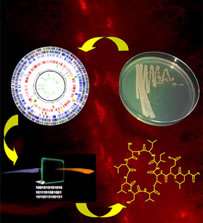
The method developed by Gerwick and his colleagues employs a novel combination of genomic sequence analysis and isotope labeling. The new “genomisotopic approach” is described in the new issue of Chemistry & Biology as the journal’s featured cover paper.
Gerwick says the key to the genomisotopic approach lies in the combined power of
bioinformatics—computer programming to predict the proteins as well as the component building blocks they will use to make the new mystery product—with the ability to provide building blocks containing distinctive isotope labels to cultures producing the mystery compound. The microorganism assimilates the isotope-tagged precursors, incorporates them into the mystery compound, thus enabling the researchers to “find” the mystery compound simply by looking for the isotope signature. According to the paper, the approach represents a valuable complement to existing genome “mining” strategies.
“This technique allows us to methodically and with a very well-defined strategy figure out and isolate the compounds that are produced from those orphan gene clusters,” said Gerwick. “With the genomisotopic approach we’re mapping out a metabolic process. We’re watching the incorporation of the amino acid into a more complex natural products structure and visualizing it at the end by a combination of mass spectrometry and nuclear magnetic resonance spectroscopy.”
The genomisotopic approach was born out of a failed experiment in Gerwick’s laboratory. A student had attempted to clone the biosynthetic gene cluster for a certain compound. The student sequenced a stretch of DNA that initially appeared promising as the correct gene cluster, but ultimately proved not to be.
“So with that big stretch of DNA we scratched our heads and wondered, if it didn’t make the compound we thought it did, what did it make?” said Gerwick. “We brainstormed and thought we could come up with an approach for finding out.”
In addition to describing the genomisotopic approach, the Chemistry & Biology paper describes the identification of a compound of a previously unknown natural product discovered through the new method. Gerwick and his colleagues applied the approach and found what is now known as orfamide A, a new natural product that may prove beneficial in agriculture and crop protection due to its potential in suppressing plant diseases.
Gerwick says the new approach will now be applied to various organisms derived from the ocean, including marine bacteria.
In addition to Gerwick, the paper’s coauthors include Harald Gross (Scripps and Oregon State University), Virginia Stockwell (Oregon State University), Marcella Henkels (U.S. Department of Agriculture), Brian Nowak-Thompson (Northland College) and Joyce Loper (U.S. Department of Agriculture).
Source: By Mario Aguilera, UCSD


