Cassini's Photo Album From a Season of Icy Moons
Dec 07, 2005
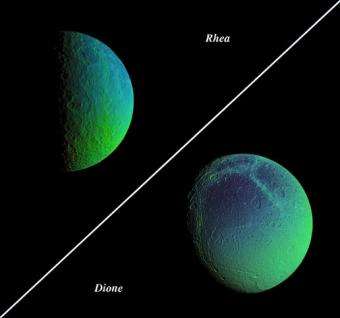
False-color views of Saturn's cratered, icy moons, Rhea and Dione. Image credit: NASA/JPL/Space Science Institute

Wrapping up a phenomenally successful year of observing Saturn's icy moons, the Cassini mission is releasing a flood of new views of the moons Enceladus, Dione, Rhea, Hyperion and Iapetus.

Image: False-color views of Saturn's cratered, icy moons, Rhea and Dione. Image credit: NASA/JPL/Space Science Institute

The moons and their intricacies are being highlighted at a news briefing today at the American Geophysical Union meeting in San Francisco.

Several new images of Rhea, a moon measuring 1,528 kilometers (949 miles) across, were taken during Cassini's most recent close flyby on November 26. During the encounter, Cassini dipped to within 500 kilometers (310 miles) of Rhea's surface.

Additional new images include two "zoomable" mosaics of Rhea and Hyperion at high resolution; false-color views revealing compositional variation on the surfaces of Hyperion, Dione and Rhea; two movies reproducing Cassini's exciting encounters with Iapetus and Hyperion; and dazzling new images of the plumes of Enceladus, including a time-lapse movie.

The Cassini-Huygens mission is a cooperative project of NASA, the European Space Agency and the Italian Space Agency. The Jet Propulsion Laboratory, a division of the California Institute of Technology in Pasadena, manages the Cassini-Huygens mission for NASA's Science Mission Directorate, Washington. The Cassini orbiter and its two onboard cameras were designed, developed and assembled at JPL. The imaging team is based at the Space Science Institute, Boulder, Colo.

The image products being released include large mosaics, movies and false-color views. They are available at ciclops.org .

Source: NASA

Explore further: Scientists: Soggy British weather likely to stay

add to favorites email to friend print save as pdf

Related Stories

Cassini captures new images of icy moon Rhea

Mar 12, 2012

(PhysOrg.com) -- These raw, unprocessed images of Saturn's second largest moon, Rhea, were taken on March 10, 2012, by NASA's Cassini spacecraft. This was a relatively distant flyby with a close-approach distance ...

Cassini presents Saturn moon quintet

Sep 19, 2011

(PhysOrg.com) -- With the artistry of a magazine cover shoot, NASA's Cassini spacecraft captured this portrait of five of Saturn's moons poised along the planet's rings.

Cassini marks holidays with dramatic views of Rhea

Dec 21, 2010

(PhysOrg.com) -- Newly released for the holidays, images of Saturn's second largest moon Rhea obtained by NASA's Cassini spacecraft show dramatic views of fractures cutting through craters on the moon's surface, ...

NASA Extends Cassini's Grand Tour of Saturn

Apr 15, 2008

NASA is extending the international Cassini-Huygens mission by two years. The historic spacecraft's stunning discoveries and images have revolutionized our knowledge of Saturn and its moons.

Recommended for you

The contribution of particulate matter to forest decline

26 minutes ago

Air pollution is related to forest decline and also appears to attack the protecting wax on tree leaves and needles. Bonn University scientists have now discovered a responsible mechanism: particulate matter ...

World Bank warns global warming woes closing in

2 hours ago

The World Bank on Wednesday warned that severe hardships from global warming could be felt within a generation, with a new study detailing devastating impacts in Africa and Asia.

User comments : 0

More news stories

Seeing data

More data are being created, consumed, and transported than ever before, and in all areas of society, including business, government, health care, and science. The hope and promise is that this influx of ...

Diabetes key to transplant success, research finds

(Medical Xpress)—Better management of diabetes could dramatically improve outcomes for lung transplant patients, with new research showing that those without diabetes lived twice as long as transplant recipients ...