Moist Soil 'Hot Spots' May Affect Rainfall
While the Earth is moistened by rainfall, scientists believe that the water in soil can, in turn, influence rainfall both regionally and globally. Forecasters, water resource managers and farmers may benefit once this connection is better understood.
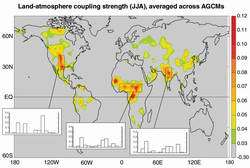
A NASA researcher led an effort that used a dozen computer models to locate "hot spots" around the world where soil moisture may strongly affect rainfall during northern hemisphere summertime. The results appear in the August 20 issue of Science Magazine.
The "hot spots" appear in the central plains of North America, the Sahel, equatorial Africa, and India. Less intense hot spots show up in South America, central Asia and China. These hot spots are, in a sense, analogous to ocean areas where sea surface temperatures strongly affect climate and weather, the most famous example being in the eastern tropical Pacific, where El Ninos occur.
"The study arguably provides the best estimate ever of the areas where soil moisture changes can affect rainfall," said Randal Koster, a researcher at NASA's Goddard Space Flight Center in Greenbelt, Md. Koster led the international computer modeling effort in collaboration with Paul Dirmeyer and Zhichang Guo of the Center for Ocean Land Atmosphere Studies, Calverton, Md.
In the Global Land-Atmosphere Coupling Experiment (GLACE), Koster and colleagues duplicated the same experiment using 12 different computer models from around the world. With each model researchers compared the rainfall behavior in two sets of simulations: one in which the soil moisture differed between the simulations, and one in which all simulations saw the same soil moisture. Any increase in rainfall agreement in the second set of simulations shows an impact of soil moisture on the rainfall.
Although the model results differed, the simulations also shared certain common features. By averaging together all the findings, the researchers identified the common features, or "hot spots" where soil moisture influences rainfall the most.
If soil moisture is assumed to affect rain locally, the hot spots tell researchers who study land and atmosphere interactions where to focus their measurements. NASA helps in the design of satellites and instruments to measure soil moisture. Currently, the Advanced Microwave Scanning Radiometer for EOS on NASA's Aqua satellite measures the moisture in surface soil down to a depth of a few centimeters. In 2009, NASA plans to launch the Hydrosphere State (HYDROS) mission that will provide the first global view of the Earth?s changing soil moisture down to 5 centimeters.
However, even if researchers could observe global soil moisture levels at depths greater than a few centimeters, it would be very hard to tell from the data alone how this moisture contributes to precipitation. There are too many factors involved. "Computer models are notorious for their limitations. Still, given the overwhelming difficulty of finding the hot spots through direct measurement, our study provides the next best thing: a multi-model estimate of their locations," Koster said.
In general, the hot spots have one thing in common: they occur in transition zones between wet and dry regions. This was expected. In wet climates, the Sun's energy and cloudiness play a bigger role in determining evaporation rates than soil moisture. In dry climates, the limited water leads to limited evaporation rates, that are simply too small to have a large impact on the atmosphere. The fact that satellites cannot measure soil moisture through very dense vegetation is therefore less of a problem. Dense vegetation appears in wet regions, where the hot spots are typically not found.
Understanding soil moisture levels and their connection to precipitation has important implications. It may improve seasonal forecasting of rainfall vital to water managers, as well as improve the accuracy of short-term weather forecasts. Interest in the study is therefore high at national weather centers, like the National Centers for Environmental Prediction (NCEP), Camp Springs, Md.
"At NCEP, we are working on ways to specify soil moisture accurately, in order to take advantage of the type of connections examined in GLACE," said co-author Kenneth Mitchell of NCEP. NCEP's soil moisture estimation project, known as the Land Data Assimilation System, is run in collaboration with scientists at NASA. Institutions from the United States, Canada, the United Kingdom, Japan, and Australia each funded use of their own model.
Source: NASA


