'Jammed Networks' may clear the way for better nanomaterials
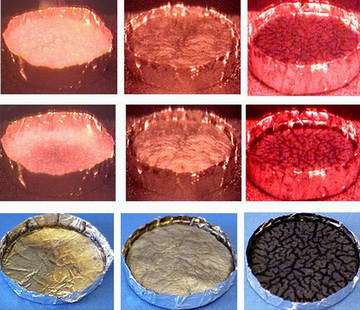
Jammed networks may cause upheaval in phone systems, but among wispy carbon nanotubes or nanofibers, a similar phenomenon may greatly improve flammability resistance and, perhaps, other properties in polymers, report researchers from the National Institute of Standards and Technology and the University of Pennsylvania.
Image: Video sequences reveal how different additives affect the behavior of a plastic material (PMMA) when heated under fire-like conditions. Top two rows show behavior during heating, and the bottom shows the final residue. Unmodified PMMA (left) behaves like a liquid, bubbling vigorously and leaving almost no residue. Adding a tiny dash (0.5 wt percent) of single-walled carbon nanotubes (center) nearly eliminated bubbling; the residue was slightly thinner than the original sample, and it had a smooth undulating surface. Numerous small “islands” formed during heating of the material with multi-walled carbon nanotubes (MWNTs) and vigorous bubbling was observed among islands. With continued heating, islands eventually coagulated, forming large islands separated by deep cracks. Image credit: NIST
Results achieved with two types of carbon nanotubes (single- and multi-walled) and with carbon nanofibers could help to eliminate trial-and-error in designing and producing nanocomposite materials with flame-retarding and other desired properties optimized for applications in areas ranging from packaging and electronics to construction and aerospace. The work appears in the December issue of Nature Materials.
Nanoparticle fillers--especially clays--have been shown to reduce the flammability of plastics and other polymers. Previous work on these nanoclay flame retardants, says NIST fire researcher Takashi Kashiwagi, indicates that the additives are most effective when they migrate to form a continuous surface layer, creating a "heat shield" on top of the more flammable polymer matrix. The shield, he explains, suppresses the "vigorous bubbling" that can occur as the matrix breaks down.
However, if the plate-like nanoclay particles cluster into islands, heat escapes through cracks between them, compromising their performance as flame retardants.
To get around this problem, Kashiwagi and colleagues chose to investigate carbon nanotubes and nanofibers, which tend to be narrower and longer than nanoclays. These structures also have been shown to enhance strength, electrical conductivity and other material properties. The researchers reasoned that the extended, sinuous geometry of the tiny tubes and fibers might lend itself to forming a "continuous, network-structured protective layer" that is free of cracks.
When the researchers heated polymethyl methacrylate (PMMA)--a clear plastic--dispersed with carbon nanotubes or nanofibers, the material behaved like a gel. In a process dictated by their type, concentration and other factors, the nano additives dispersed throughout the PMMA matrix and eventually achieved a "mechanically stable network structure." The researchers say the "jammed networks" formed as the nanocomposites underwent a change in identity, a transition from liquid to solid. The shift occurred at an optimal composition that the team called the "gel concentration."
For single-walled carbon nanotubes--sheets of carbon atoms rolled into cylinders--top fire retardant performance was achieved when the fillers made up only 0.5 percent of the total mass of the material. For multi-walled carbon nanotubes, which are nested sets of carbon cylinders, the gel concentration was 1 percent. Both types of nanotubes have the potential to surpass nanoclays as effective fire retardants, says NIST materials scientist Jack Douglas.
Results suggest that the gel concentration also may mark the point at which other nanotube-enabled improvements in material properties are maximized, Douglas adds.
Publication: T. Kashiwagi, F. Du, J.F. Douglas, K.I. Winey, R.H. Harris Jr., and J.R. Shields. Nanoparticle networks reduce the flammability of polymer nanocomposites. Nature Materials, December 2005, 928-933.
Source: NIST


