Chandra proves black hole influence is far reaching
Dec 01, 2005
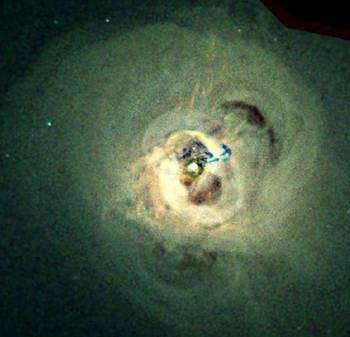
X-ray image of Perseus Cluster

Scientists using NASA's Chandra X-ray Observatory have discovered evidence of energetic plumes – particles that extend 300,000 light years into a massive cluster of galaxies. The plumes are due to explosive venting from the vicinity of a supermassive black hole, and they provide dramatic new evidence of the influence a black hole can have over intergalactic distances.

Image: X-ray image of Perseus Cluster. Credit: NASA/CXC/IoA/J.Sanders et al

"In relative terms, it is as if a heat source the size of a fingernail affects the behavior of a region the size of Earth," said Andrew Fabian of Cambridge University, U.K. Fabian is lead author of a report on this research that will appear in an upcoming issue of the Monthly Notices of the Royal Astronomical Society.

Fabian's group discovered the plumes by studying data from 280 hours (more than 1 million seconds) of Chandra observations of the Perseus cluster, the longest X-ray observation ever taken of a galaxy cluster. The cluster contains thousands of galaxies immersed in a vast cloud of multi-million degree gas with the mass equivalent of trillions of suns.

The plumes showed up in the X-ray data as low pressure regions in the hot gas extending outward from the giant galaxy in the center of the cluster. The low gas pressure measured in the plumes is likely the result of the displacement of the gas by bubbles of unseen high-energy particles.

The bubbles appear to be generated by high-speed jets blasting away from the vicinity of the giant galaxy's supermassive black hole. Individual bubbles seen in the inner regions expand and merge to create vast plumes at larger distances.

"The plumes show that the black hole has been venting for at least 100 million years, and probably much longer," said co-author Jeremy Sanders also of Cambridge University.

The venting produces sound waves which heat the gas throughout the inner regions of the cluster and prevent the gas from cooling and making stars at a large rate. This process has slowed the growth of the central galaxy in the cluster, NGC 1275, which is one of the largest galaxies in the universe.

Source: Chandra X-ray Center

Explore further: Worsening smog angers Singaporeans, tourists

add to favorites email to friend print save as pdf

Related Stories

Sweeping the dust from a cosmic lobster

Feb 20, 2013

(Phys.org)—A new image from ESO's VISTA telescope captures a celestial landscape of glowing clouds of gas and tendrils of dust surrounding hot young stars. This infrared view reveals the stellar nursery ...

Enceladus plume is a new kind of plasma laboratory

May 31, 2012

(Phys.org) -- Recent findings from NASA's Cassini mission reveal that Saturn's geyser moon Enceladus provides a special laboratory for watching unusual behavior of plasma, or hot ionized gas. In these recent ...

The Sun's crowning glory

May 11, 2012

(Phys.org) -- Those who experience a total solar eclipse are overwhelmed as they look at the circle of light that surrounds our Sun. Laypeople may find it enchanting, but researchers have been racking their ...

Boron-nitride nanotubes show potential in cancer treatment

Apr 26, 2012

A new study has shown that adding boron-nitride nanotubes to the surface of cancer cells can double the effectiveness of Irreversible Electroporation, a minimally invasive treatment for soft tissue tumors in the liver, lung, ...

Image: Where stars are born

Dec 23, 2010

(PhysOrg.com) -- This mosaic image is the sharpest wide-angle view ever obtained of the starburst galaxy, Messier 82 (M82). The galaxy is remarkable for its bright blue disk, webs of shredded clouds and fiery-looking ...

Recommended for you

World Bank warns global warming woes closing in

1 hour ago

The World Bank on Wednesday warned that severe hardships from global warming could be felt within a generation, with a new study detailing devastating impacts in Africa and Asia.

User comments : 0

More news stories

Dish won't submit revised bid for Sprint

Satellite TV operator Dish Network Corp. said Tuesday it would not submit a revised bid for Sprint, leaving the path open for the wireless carrier to accept what it already considers a superior offer from Japan's Softbank.

Cape Wind gets $200M investment from Danish fund

The Cape Wind offshore wind project has secured a $200 million investment from a Danish pension fund in what the wind farm's president said Tuesday is a milestone for the long-delayed project.