Deciphering the Mystery of Bee Flight
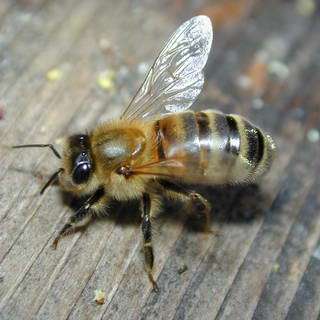
One of the most elusive questions in science has finally been answered: How do bees fly? Although the issue is not as profound as how the universe began or what kick-started life on earth, the physics of bee flight has perplexed scientists for more than 70 years. In 1934, in fact, French entomologist August Magnan and his assistant André Sainte-Lague calculated that bee flight was aerodynamically impossible. The haphazard flapping of their wings simply shouldn't keep the hefty bugs aloft.
And yet, bees most certainly fly, and the dichotomy between prediction and reality has been used for decades to needle scientists and engineers about their inability to explain complex biological processes.
Now, Michael H. Dickinson, the Esther M. and Abe M. Zarem Professor of Bioengineering, and his postdoctoral student Douglas L. Altshuler and their colleagues at Caltech and the University of Nevada at Las Vegas, have figured out honeybee flight using a combination of high-speed digital photography, to snap freeze-frame images of bees in motion, and a giant robotic mock-up of a bee wing. The results of their analysis appear in the November 28 issue of the Proceedings of the National Academy of Sciences.
"We're no longer allowed to use this story about not understanding bee flight as an example of where science has failed, because it is just not true," Dickinson says.
The secret of honeybee flight, the researchers say, is the unconventional combination of short, choppy wing strokes, a rapid rotation of the wing as it flops over and reverses direction, and a very fast wing-beat frequency.
"These animals are exploiting some of the most exotic flight mechanisms that are available to insects," says Dickinson.
Their furious flapping speed is surprising, Dickinson says, because "generally the smaller the insect the faster it flaps. This is because aerodynamic performance decreases with size, and so to compensate small animals have to flap their wings faster. Mosquitoes flap at a frequency of over 400 beats per second. Birds are more of a whump, because they beat their wings so slowly."
Being relatively large insects, bees would be expected to beat their wings rather slowly, and to sweep them across the same wide arc as other flying bugs (whose wings cover nearly half a circle). They do neither. Their wings beat over a short arc of about 90 degrees, but ridiculously fast, at around 230 beats per second. Fruit flies, in comparison, are 80 times smaller than honeybees, but flap their wings only 200 times a second.
When bees want to generate more power--for example, when they are carting around a load of nectar or pollen--they increase the arc of their wing strokes, but keep flapping at the same rate. That is also odd, Dickinson says, because "it would be much more aerodynamically efficient if they regulated not how far they flap their wings but how fast "
Honeybees' peculiar strategy may have to do with the design of their flight muscles.
"Bees have evolved flight muscles that are physiologically very different from those of other insects. One consequence is that the wings have to operate fast and at a constant frequency or the muscle doesn't generate enough power," Dickinson says.
"This is one of those cases where you can make a mistake by looking at an animal and assuming that it is perfectly adapted. An alternate hypothesis is that bee ancestors inherited this kind of muscle and now present-day bees must live with its peculiarities," Dickinson says.
How honeybees make the best of it may help engineers in the design of flying insect-sized robots: "You can't shrink a 747 wing down to this size and expect it to work, because the aerodynamics are different," he says. "But the way in which bee wings generate forces is directly applicable to these devices."
Source: Caltech
