'Speechless' and 'Mute' help break the silence of the leaves
Dec 20, 2006
'Speechless' and 'Mute' help break the silence of the leaves
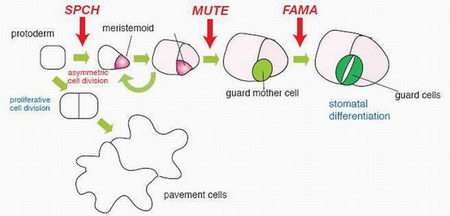
The gene Speechless drives the division that initiates stomatal development. (Without Speechless, cells become the wax-coated, interlocking pavement cells on the surface of the plant, none of which open or close.) Two or three divisions after Speechless, Mute causes the formation of a guard mother cell. Then Fama causes the guard mother cell to divide into two equal guard cells that, as their name implies, guard the opening of the stomatal pore. Credit: University of Washington

Researchers have discovered two genes that guide land plants to develop microscopic pores that they can open and close as if each pore was a tiny mouth. Plants wouldn't have been able to move from water to land 400 million years ago if they hadn't evolved this ability, which protects them from losing too much moisture.

The leaves and stems of land plants are dotted with the "tiny mouths," called stomata. When open, stomata allow the plant to take in carbon dioxide gas needed for photosynthesis and allow moisture to evaporate, pulling water from the roots into the plant. But when too much moisture is being lost, the two cells around the stomatal pore close it completely.

Without the genes guiding stomatal development, plants won't develop any mouthlike pores, hence the names Speechless and Mute for the newly discovered genes, according to Keiko Torii, a University of Washington associate professor of biology.

Her UW group and a Stanford University group have separate papers in the journal Nature's advance-online publication Dec. 20. Each group describes independently finding the gene that came to be called Speechless and its role in initiating the process that leads to stomata.

In addition, Torii's UW group is publishing findings in its Nature article about another gene, one they named Mute, that triggers the key middle step that decides when a cell will fully become a stomata. Earlier this year the Stanford group published findings about the gene that controls the final step in stomata development, called Fama.

"In the last few months, we've gone from knowing surprisingly little about the genes involved to knowing all three major factors -- Speechless, Mute and Fama," says Lynn Pillitteri, a research associate in biology and lead author of the Nature paper.

That the three are so closely related will be of interest to biologists studying both plants and animals, she says. Each is a basic protein with a helix-loop-helix domain, a sequence that is quite ancient and controls a vast range of physiological and developmental processes. Speechless, Mute and Fama also have very similar DNA sequences and could have arisen from a single gene that replicated and evolved, giving plants additional genes with slightly different characteristics.

Having two or three genes with similar characteristics would give plants what Torii terms "the freedom to play, to make functions that are the more elaborate stomata in modern plants."

Other biologists have seen something similar in animals. The ability to differentiate cells that become muscles also is controlled by consecutive action of basic helix-loop-helix proteins with DNA closely related to each other.

Molecular conservation of such key regulatory genes between plants and animals -- genes that switch on and off cell-type differentiation programs from precursor stem cells -- is intriguing and exciting, Torii says.

In addition to Pillitteri and Torii, who is the corresponding author, the other co-authors are Daniel Sloan, a former UW technician now pursuing a doctorate at University of Virginia, and Naomi Bogenschutz, a research technician.

Source: University of Washington

Explore further: 100K Pathogen Genome Project maps first genomes

add to favorites email to friend print save as pdf

Related Stories

When a gene is worth 2

Mar 22, 2013

The notion that each gene can only codify for a single protein has been challenged for some years. Yet, the functional outcomes that may result from genes encoding more than one protein are still largely unknown.

Steroids control gas exchange in plants

Feb 05, 2012

Plants leaves are sealed with a gas-tight wax layer to prevent water loss. Plants breathe through microscopic pores called stomata (Greek for mouths) on the surfaces of leaves. Over 40% of the carbon dioxide, CO2, in the ...

A new transporter gene that regulates plant transpiration

Sep 09, 2011

When plants feel stress from a lack of water, they close their epidermal pores, or stomata, to prevent water loss via transpiration. Each stoma is flanked by a pair of guard cells, which change shape to close or open stomata ...

On guard against drought

Oct 28, 2011

Identification of a gene that helps plants to conserve water under drought conditions will bring biologists closer to understanding how plants tolerate drought. Researchers, led by Takashi Kuromori at Japan's ...

Recommended for you

100K Pathogen Genome Project maps first genomes

9 minutes ago

(Phys.org) —Striking a blow at foodborne diseases, the 100K Pathogen Genome Project at the University of California, Davis, today announced that it has sequenced the genomes of its first 10 infectious microorganisms, including ...

Getting to the bottom of the zombie ant phenomenon

9 minutes ago

(Phys.org) —While unraveling a dramatic case of mind control, biologist David Hughes is taking calls from Hollywood—and gaining new insights into the role behavior plays in spreading disease.

New DNA cattle test beefs up dairy and meat quality

19 minutes ago

(Phys.org) —A genomics technique developed at Cornell to improve corn can now be used to improve the quality of milk and meat, according to research published online May 17 in the journal PLOS ONE.

Strawberry fields forever and fungus-free

27 minutes ago

(Phys.org) —Strawberries are one of the most economically important berry crops in the world, and a high value export crop for the Australian horticultural industry.For the first time, researchers at The ...

Coral reefs 'ruled by earthquakes and volcanoes'

59 minutes ago

(Phys.org) —Titanic forces in the Earth's crust explain why the abundance and richness of corals varies dramatically across the vast expanse of the Indian and Pacific Oceans, a world-first study from the ...

User comments : 0

More news stories

Coral reefs 'ruled by earthquakes and volcanoes'

(Phys.org) —Titanic forces in the Earth's crust explain why the abundance and richness of corals varies dramatically across the vast expanse of the Indian and Pacific Oceans, a world-first study from the ...

Coccoliths thrive despite ocean acidification

Ocean acidification is damaging some marine species while others thrive, say scientists. An international team studied the effect of ocean acidification on plankton in the North Sea over the past forty years, ...

Strawberry fields forever and fungus-free

(Phys.org) —Strawberries are one of the most economically important berry crops in the world, and a high value export crop for the Australian horticultural industry.For the first time, researchers at The ...

Single-cell sequencing

When studying any kind of population—people or cells—averaging is a useful, if flawed, form of measurement. According to the US Census Bureau, the average American household size in 2010 was 2.59. Of ...

Theorists weigh in on where to hunt dark matter

(Phys.org) —Now that it looks like the hunt for the Higgs boson is over, particles of dark matter are at the top of the physics "Most Wanted" list. Dozens of experiments have been searching for them, but ...