Human-chimp difference may be bigger
Dec 20, 2006
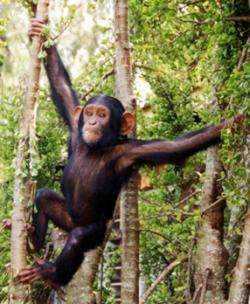
Chimpanzees

Approximately 6 percent of human and chimp genes are unique to those species, report scientists from Indiana University Bloomington and three other institutions. The new estimate, reported in the inaugural issue of Public Library of Science ONE (Dec. 2006), takes into account something other measures of genetic difference do not -- the genes that aren't there.

That isn't to say the commonly reported 1.5 percent nucleotide-by-nucleotide difference between humans and chimps is wrong, said IUB computational biologist Matthew Hahn, who led the research. IUB postdoctoral researcher Jeffery Demuth is the paper's lead author.

"Both estimates are correct in their own way," Hahn said. "It depends on what you're asking. There isn't a single, standard estimate of variation that incorporates all the ways humans, chimps and other animals can be genetically different from each other."

By studying "gene families" -- sets of genes in every organism's genome that are similar (or identical) because they share a common origin -- the scientists also provide new information about the evolution of humanness. After surveying gene families common to both humans and chimps, the researchers observed in the human genome a significant increase in the duplication of genes that influence brain functions.

"Our results support mounting evidence that the simple duplication and loss of genes has played a bigger role in our evolution than changes within single genes," Hahn said.

That finding complements reports by University of Colorado and University of Michigan researchers in the journals Science and PLoS Biology earlier this year, in which researchers showed that both gains and losses of individual genes have contributed to human divergence from chimpanzees and other primates.

Hahn and his research partners examined 110,000 genes in 9,990 gene families that are shared by humans, common chimpanzees (Pan troglodytes), mice, rats and dogs. The scientists found that 5,622, or 56 percent, of the gene families they studied from these five species have grown or shrunk in the number of genes per gene family, suggesting changes in gene number have been so common as to constitute an evolutionary "revolving door."

The researchers paid special attention to gene number changes between humans and chimps. Using a statistical method they devised, the scientists inferred humans have gained 689 genes (through the duplication of existing genes) and lost 86 genes since diverging from their most recent common ancestor with chimps. Including the 729 genes chimps appear to have lost since their divergence, the total gene differences between humans and chimps was estimated to be about 6 percent.

Hahn said any serious measure of genetic difference between humans and chimps must incorporate both variation at the nucleotide level among coding genes and large-scale differences in the structure of human and chimp genomes. The real question biologists will face is not which measure is correct but rather which sets of differences have been more important in human evolution.

"That's not for me to decide," he said.

Source: Indiana University

Explore further: Why we need to put the fish back into fisheries

add to favorites email to friend print save as pdf

Related Stories

Why can we talk? 'Humanized' mice speak volumes

May 28, 2009

Mice carrying a "humanized version" of a gene believed to influence speech and language may not actually talk, but they nonetheless do have a lot to say about our evolutionary past, according to a report in the May 29th issue ...

Recommended for you

Why we need to put the fish back into fisheries

2 hours ago

Overfishing has reduced fish populations and biodiversity across much of the world's oceans. In response, fisheries are increasingly reliant on a handful of highly valuable shellfish. However, new research by the University ...

Engineered microbes grow in the dark

2 hours ago

Scientists at the University of California, Davis have engineered a strain of photosynthetic cyanobacteria to grow without the need for light. They report their findings today at the 113th General Meeting of the American ...

Lovelorn frogs bag closest crooner

2 hours ago

What lures a lady frog to her lover? Good looks, the sound of his voice, the size of his pad or none of the above? After weighing up their options, female strawberry poison frogs (Oophaga pumilio) bag th ...

Honeybees trained in Croatia to find land mines

20 hours ago

(AP)—Mirjana Filipovic is still haunted by the land mine blast that killed her boyfriend and blew off her left leg while on a fishing trip nearly a decade ago. It happened in a field that was supposedly ...

Front-row seats to climate change

May 17, 2013

By day, insects provide the white noise of the South, but the night belongs to the amphibians. In a typical year, the Southern air hangs heavy from the humidity and the sounds of wildlife.

User comments : 0

More news stories

Lovelorn frogs bag closest crooner

What lures a lady frog to her lover? Good looks, the sound of his voice, the size of his pad or none of the above? After weighing up their options, female strawberry poison frogs (Oophaga pumilio) bag th ...

Why we need to put the fish back into fisheries

Overfishing has reduced fish populations and biodiversity across much of the world's oceans. In response, fisheries are increasingly reliant on a handful of highly valuable shellfish. However, new research by the University ...

Engineered microbes grow in the dark

Scientists at the University of California, Davis have engineered a strain of photosynthetic cyanobacteria to grow without the need for light. They report their findings today at the 113th General Meeting of the American ...

Honeybees trained in Croatia to find land mines

(AP)—Mirjana Filipovic is still haunted by the land mine blast that killed her boyfriend and blew off her left leg while on a fishing trip nearly a decade ago. It happened in a field that was supposedly ...

Expectations high for next Xbox

It's almost time for a new Xbox. Eight years have passed since Microsoft unveiled the Xbox 360, double the amount of time between the original Xbox debut in 2001 and its high-definition successor's launch ...

US adviser on board of firm that sold anthrax drug

(AP)—Former Navy Secretary Richard J. Danzig, who has served as a bio-warfare adviser to the president, the Pentagon, and the Department of Homeland Security, urged the government to stockpile an anti-anthrax drug while ...