Stretch a DNA Loop, Turn Off Proteins
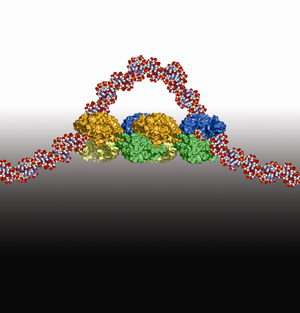
It may look like mistletoe wrapped around a flexible candy cane. But this molecular model shows how some proteins form loops in DNA when they chemically attach, or bind, at separate sites to the double-helical molecule that carries life’s genetic blueprint.
Biologists have discovered that the physical manifestation of DNA loops are a consequence of many biochemical processes in the cell, such as the regulation of gene expression. In other words, these loops indicate the presence of enzymes or other proteins that are turned on. Now physicists at the University of California, San Diego have discovered that stretching the DNA molecule can also turn off the proteins known to cause loops in DNA.
“We showed that certain enzymes acting on DNA could be switched off or on simply by applying a small amount of mechanical tension across the DNA molecule,” said Douglas Smith, an assistant professor of physics at UCSD who headed the team that published the discovery in the December issue of the Biophysical Journal.
“We showed this by mechanically manipulating and stretching single DNA molecules. This switching effect could provide a molecular mechanism for cells to be able to sense and respond to mechanical stresses that they may normally experience. Such stresses could be generated internally by the cells themselves, such as when the cell undergoes changes in shape during the cell cycle, or as external stresses from the environment.”
The amount of tension or stretching that needs to be applied to the molecule is extremely small, Smith added, only one pico-Newton, or one-trillionth of the force generated by the weight of an apple.
Other members of the UCSD team were Gregory Gemmen, a physics graduate student, and Rachel Millin, a laboratory assistant. The study was supported by grants from the Burroughs Wellcome Fund, Kinship Foundation and Arnold and Mabel Beckman Foundation.
Source: UCSD


