Genetically engineered blood protein can be used to split water into oxygen and hydrogen
Dec 01, 2006
Genetically engineered blood protein can be used to split water into oxygen and hydrogen

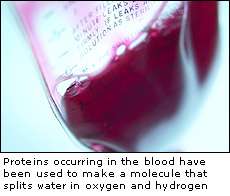
Scientists have combined two molecules that occur naturally in blood to engineer a molecular complex that uses solar energy to split water into hydrogen and oxygen, says research published today in the Journal of the American Chemical Society.

This molecular complex can use energy from the sun to create hydrogen gas, providing an alternative to electrolysis, the method typically used to split water into its constituent parts. The breakthrough may pave the way for the development of novel ways of creating hydrogen gas for use as fuel in the future.

Professors Tsuchida and Komatsu from Waseda University, Japan, in collaboration with Imperial College London, synthesised a large molecular complex from albumin, a protein molecule that is found at high levels in blood serum, and porphyrin, a molecule which is used to carry oxygen around the body and gives blood its deep red colour. Porphyrin molecules are normally found combined with metals, and in their natural state in the blood they have an iron atom at their centre. The scientists modified the porphyrin molecule to swap the iron for a zinc atom in the middle, which completely changed the chemistry and characteristics of the molecule.

This modified porphyrin molecule was then combined with albumin; with the albumin molecule itself being modified by genetic engineering to enhance the efficiency of the process. The resulting molecular complex was proven to be sensitive to light, and can capture light energy in a way that allows water molecules to be split into molecules of hydrogen and oxygen.

Dr Stephen Curry, a structural biologist from Imperial College London's Division of Cell and Molecular Biology who participated in the research explains: "This work has shown that it is possible to manipulate molecules and proteins that occur naturally in the human body by changing one small detail of their make-up, such as the type of metal at the heart of a porphyrin molecule, as we did in this study.

"It's very exciting to prove that we can use these biological structures as a conduit to harness solar energy to separate water out into hydrogen and oxygen. In the long term, these synthetic molecules may provide a more environmentally friendly way of producing hydrogen, which can be used as a 'green' fuel."

Source: Imperial College London

Explore further: Attacking MRSA with metals from antibacterial clays

add to favorites email to friend print save as pdf

Related Stories

Recommended for you

Attacking MRSA with metals from antibacterial clays

May 17, 2013

In the race to protect society from infectious microbes, the bugs are outrunning us. The need for new therapeutic agents is acute, given the emergence of novel pathogens as well as old foes bearing heightened antibiotic resistance.

Beautiful 'flowers' self-assemble in a beaker

May 16, 2013

By simply manipulating chemical gradients in a beaker of fluid, materials scientists at Harvard have found that they can control the growth behavior of crystals to create precisely tailored structures—such ...

Reading the unreadable

May 16, 2013

Pioneering X-ray technology is making it possible to read fragile rolled-up historical documents for the first time in centuries.

Keeping fruit, vegetables and cut flowers fresh longer

May 15, 2013

New technology offers the promise of reducing billions of dollars of losses that occur each year from the silent, invisible killer of fruits, vegetables and cut flowers—a gas whose effects are familiar to everyone who has ...

User comments : 0

More news stories

Attacking MRSA with metals from antibacterial clays

In the race to protect society from infectious microbes, the bugs are outrunning us. The need for new therapeutic agents is acute, given the emergence of novel pathogens as well as old foes bearing heightened antibiotic resistance.

Beautiful 'flowers' self-assemble in a beaker

By simply manipulating chemical gradients in a beaker of fluid, materials scientists at Harvard have found that they can control the growth behavior of crystals to create precisely tailored structures—such ...

Making gold green: New non-toxic method for mining gold

Northwestern University scientists have struck gold in the laboratory. They have discovered an inexpensive and environmentally benign method that uses simple cornstarch—instead of cyanide—to isolate gold from raw materials ...

US seizes Bitcoin operator accounts

US authorities seized the accounts of a Bitcoin digital currency exchange operator, claiming it was functioning as an "unlicensed money service business," court documents showed Friday.

Morocco to harness the wind in energy hunt

Morocco is ploughing ahead with a programme to boost wind energy production, particularly in the southern Tarfaya region, where Africa's largest wind farm is set to open in 2014.