MIT researchers visit Mars on Earth
At 75 degrees north latitude, Devon Island lies high above the Arctic Circle, a few hundred miles from the magnetic North Pole. A true polar desert, it is also the largest uninhabited island on Earth. But the reach of MIT extends even here.
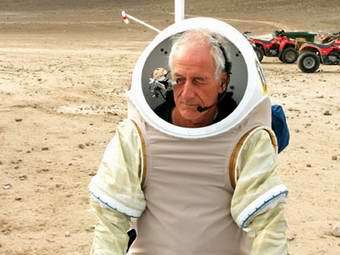
Image: MIT Professor Jeffrey Hoffman tests a Hamiliton Sundstrand concept spacesuit while at the Haughton-Mars Base on Devon Island last summer. Photo / Jessica Marquez
This past summer, a research team from MIT's Department of Aeronautics and Astronautics established a semi-permanent shelter at the NASA Haughton-Mars Base. Supported by a NASA grant on interplanetary supply chain management, the team went to Devon Island because the existing base infrastructure, combined with the remote and barren location, makes it ideal for studying logistics strategies that could be used in planning exploration strategies to the moon and Mars. The principal investigators for the project are Professors Olivier de Weck and David Simchi-Levi.
"Haughton-Mars Base provides an excellent analogy to lunar and Mars exploration," said de Weck. "This is primarily due to its remoteness, the time-varying nature of the transportation links and its thin supply line." The MIT team also included former NASA astronaut and MIT Professor Jeffrey Hoffman and seven students.
The Haughton-Mars Project is an international, interdisciplinary field research project sponsored by NASA and the Canadian Space Agency, focused on the scientific study of the Haughton Crater -- a 40-kilometer-wide geological structure formed more than 38 million years ago by the impact of a large meteor. Chosen in part for its remoteness and similarity to Mars terrain, the site also serves as an analogue or "mock" exploration base, where an array of exploration-related engineering and technology experiments are tested.
Another expedition goal was to establish an MIT presence at the Haughton base for future educational and research activities.
"The Haughton-Mars Project Devon Island base gives us a unique opportunity to conduct experimental tests of some of the ideas we've been developing for lunar and Martian exploration," Hoffman said. "We're hoping this becomes a permanent MIT facility."
The MIT team compiled a complete inventory of materials at the base, including such key items as food and fuel. It also experimented with modern logistics technologies, such as radio frequency identification, that autonomously manage and track assets, with the ultimate goal of creating a "smart exploration base" that could increase safety and save astronauts and explorers precious time.
Results from the MIT expedition are now being processed. These findings will form the basis for continued work on interplanetary logistics through this fall.
Source: MIT


