Mars Reconnaissance Orbiter Tweaks Course, Passes Halfway Point
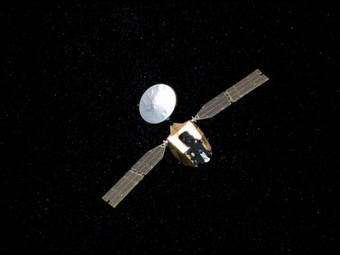
NASA's Mars Reconnaissance Orbiter successfully fired six engines for about 20 seconds today to adjust its flight path in advance of its March 10, 2006, arrival at the red planet.
Since its Aug. 12 launch, the multipurpose spacecraft has covered about 60 percent of the distance for its trip from Earth to Mars. It will fly about 40-million kilometers (25-million miles) farther before it enters orbit around Mars. It will spend half a year gradually adjusting the shape of its orbit, then begin its science phase. During that phase, it will return more data about Mars than all previous missions combined. The spacecraft has already set a record transmission rate for an interplanetary mission, successfully returning data at 6 megabits per second, fast enough to fill a CD-ROM every 16 minutes.
"Today's maneuver mainly increases the speed to bring us to the target point at just the right moment," said Tung-hanYou, chief of the Mars Reconnaissance Orbiter navigation team at NASA's Jet Propulsion Laboratory, Pasadena, Calif. The intended nudge in velocity is 75 centimeters per second (less than 2 miles per hour). The spacecraft's speed relative to the sun is about 27 kilometers per second (61,000 miles per hour).
Four opportunities for course adjustments were planned into the schedule before launch. Today's, the second, used only the trajectory-correction engines. Each engine produces about 18 newtons (4 pounds) of thrust. The first course adjustment, on Aug. 27, doubled as a test of the six main engines, which produce nearly eight times as much thrust. Those main engines will have the big job of slowing the spacecraft enough to be captured into orbit when it reaches Mars. The next scheduled trajectory adjustment, on Feb. 1, 2006, and another one 10 days before arrival will be used, if necessary, for fine tuning, said JPL's Allen Halsell, the mission's deputy navigation chief.
The Mars Reconnaissance Orbiter mission will examine Mars in unprecedented detail from low orbit. Its instrument payload will study water distribution -- including ice, vapor or liquid -- as well as geologic features and minerals. The orbiter will also support future missions to Mars by examining potential landing sites and by providing a high-data-rate relay for communications back to Earth.
Source: NASA
-
From lemons to lemonade: Reaction uses carbon dioxide to make carbon-based semiconductor,
32 comments
-
Thioridazine kills cancer stem cells in human while avoiding toxic side-effects of conventional cancer treatments,
3 comments
-
SpaceX private rocket blasts off for space station (Update),
42 comments
-
Climate scientists say they have solved riddle of rising sea,
31 comments
-
SpaceX capsule has 'new car' smell, astronauts say (Update),
4 comments
More news stories
Land and sea species differ in climate change response: study
(Phys.org) -- Marine and terrestrial species will likely differ in their responses to climate warming, new research by Simon Fraser University and Australia’s University of Tasmania has found.
8 hours ago |
4 / 5 (5) |
6
|
Yale study concludes public apathy over climate change unrelated to science literacy
Are members of the public divided about climate change because they don't understand the science behind it? If Americans knew more basic science and were more proficient in technical reasoning, would public consensus match ...
10 hours ago |
4.8 / 5 (6) |
26
|
10 million years needed to recover from mass extinction
It took some 10 million years for Earth to recover from the greatest mass extinction of all time, latest research has revealed.
Space & Earth / Earth Sciences
10 hours ago |
4.2 / 5 (5) |
2
|
Sophisticated simulations predict future warming
The chances of our planet being hit by a global warming of 3 degrees Celsius by 2050 is as likely as it being hit by an increase of 1.4 degrees, new research shows. Presented in the journal Nature Geoscience, the British study ...
Space & Earth / Earth Sciences
May 22, 2012 |
3.8 / 5 (11) |
51
Aliens don't want to eat us, says former SETI director
Alien life probably isnt interested in having us for dinner, enslaving us or laying eggs in our bellies, according to a recent statement by former SETI director Jill Tarter.
Space & Earth / Space Exploration
May 25, 2012 |
4.4 / 5 (15) |
41
'Unzipped' carbon nanotubes could help energize fuel cells, batteries
Multi-walled carbon nanotubes riddled with defects and impurities on the outside could replace some of the expensive platinum catalysts used in fuel cells and metal-air batteries, according to scientists at ...
Change in developmental timing was crucial in the evolutionary shift from dinosaurs to birds: study
At first glance, it's hard to see how a common house sparrow and a Tyrannosaurus Rex might have anything in common. After all, one is a bird that weighs less than an ounce, and the other is a dinosaur that ...
Computer model used to pinpoint prime materials for efficient carbon capture
When power plants begin capturing their carbon emissions to reduce greenhouse gases and to most in the electric power industry, it's a question of when, not if it will be an expensive undertaking.
T cells 'hunt' parasites like animal predators seek prey, study shows
By pairing an intimate knowledge of immune-system function with a deep understanding of statistical physics, a cross-disciplinary team at the University of Pennsylvania has arrived at a surprising finding: T cells use a movement ...
Stunning image of smallest possible five-ringed structure
Scientists have created and imaged the smallest possible five-ringed structure about 100,000 times thinner than a human hair and you'll probably recognise its shape.
Browser wars flare in mobile space
The browser wars are heating up again, but this time the fight is for dominance of the mobile Internet.