Daily grind: Fossil molars add to Neanderthal debate
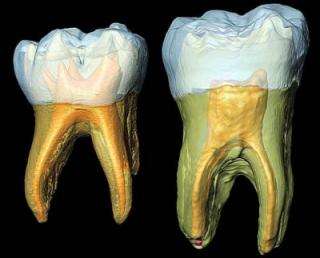
Palaeontologists have fired a new round in a verbal battle over the Neanderthals, the hominids who were our closest evolutionary cousins before they met a strange and possibly tragic end.
Scientists from the United Kingdom, France and Italy have studied teeth from Neanderthals with X-rays from the European Synchrotron Radiation Facility. They found that the dental development of Neanderthals is very similar to modern humans.
Neanderthals first appeared in Europe approximately 200,000 years ago and became extinct about 25,000 years ago. These predecessors of modern humans have always been considered genetically closer to us than any other members of the genus Homo. It has even been suggested that Neanderthals achieved adulthood faster than modern humans do today.
A research team from the United Kingdom, France and Italy has recently shed new light on this theory by studying this species’ teeth. Teeth express genetic differences found between individuals and different populations more efficiently than any other tissues preserved in the fossil record. Studies with teeth can identify a timescale on the entire period of dental development that occurs from before birth until adulthood.
Scientists used the ESRF X-rays to study the enamel dentine junction of a deciduous and a permanent Neanderthal molar tooth (approximately 130,000 years old) that was found on a site in France. The technique used to image the teeth is high-resolution tomography. The researchers noticed that the samples showed more complex folding of the enamel dentine junction than their modern human counterparts. Some of the unique surface morphologies of Neanderthal molars clearly showed a deep embryological origin and are likely to have been functionally significant.
Thin ground sections of the same Neanderthal molars revealed that the crowns and roots did not grow faster than those of modern humans. The permanent molar tooth studied had completed its root growth at about 8.7 years of age, which is typical of many modern human children today.
Almost all deciduous teeth contained an accentuated birth line, or neonatal line that results from the changing physiology and stress of birth. The Neanderthal deciduous also showed a neonatal line with evidence of the usual perinatal physiological stress but with no signs of additional postnatal stress.
Among anthropoid primates there is a close relationship between brain growth and tooth eruption. Scientists predicted that the first permanent molar eruption in this Neanderthal (6.8 years) fits a dental development schedule similar to those found in modern humans.
The next step in the research is to find out whether Neanderthal teeth from sites dated to more recent times will reveal evidence of the demographic pressures that overcame the Neanderthals as they approached extinction.
Source: European Synchrotron Radiation Facility


