Social relationships affect personality of fish, say experts
Fish who display bold or shy personality traits are influenced by watching the behaviour of others, University of Liverpool researchers have found.
Researchers found some fish alter their behaviour according to that which they observe in other fish. The team found, for example, that bold fish become much more cautious after observing the behaviour of shy fish.
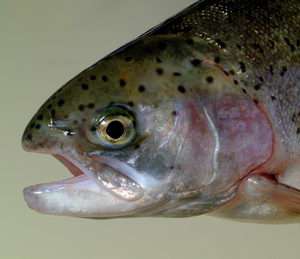
Dr Lynne Sneddon and Ashley Frost, from the University’s School of Biological Sciences, measured the responses of rainbow trout to various challenges. The team presented the fish with Lego bricks to elicit a fear response. They found that bold fish approached the object within a few minutes whereas shy fish took more than ten minutes to approach the object. This allowed the team to distinguish which were the shy fish and which were the bold fish.
Dr Sneddon said: “We allowed the fish to interact for seven days and elicited social experience by raising an opaque partition in their tank for 15 minutes a day. Rainbow trout are a highly aggressive species and naturally form relationships of dominance in a very short time period. They chase after each other to try and exert their dominance. We found the fish which attacked the most and retreated the least demonstrated their enhanced status over others. We found that bold fish that lost their ‘battle’ became shyer than usual and shy fish who won their ‘battle’ became bolder.
“Equally the more time, bold and shy fish spent watching each other the more their behaviour changed. Bold fish who observed the way shy fish reacted to the Lego objects became much more cautious in their behaviour. In contrast however, shy fish who observed bold fish did not alter their behaviour - they remained just as shy as before.”
Researchers believe that the shy fish observing bold fish decide their competitive ability is lower and so do not try to alter their behaviour. Bold fish, however, adapt their behaviour to what others are doing and as a result of low social status.
Dr Sneddon added: “Personality types have also been observed in birds, mammals, reptiles and other fish. Personality type may be a strong driving force in the evolution of populations.”
Dr Sneddon’s research is published by Proceedings of the Royal Society of London B.
Source: University of Liverpool


