Newly Adult-born Neurons Are Functionally Similar to Mature Neurons
In mammals, the production of new brain cells occurs primarily at the time the nervous system is developing, although certain brain areas generate neurons throughout adulthood. One such area is the hippocampus, a part of the brain involved in the critical function of memory and spatial perception.
Hippocampal cells, specifically dentate granule cells, are continuously produced in adults as well as in young animals. How these “adult-born” cells build their connections with the rest of the brain, and the extent to which they resemble “pup-born” cells, is of great interest to those who would like to coax other parts of adult brains to make new cells as a strategy for reversing the loss of function from trauma or degenerative disorders.
To find out whether adult-born hippocampal neurons have different properties than mature neurons that arose when the brain was developing, Diego Laplagne, Alejandro Schinder, and colleagues compared how each type of neuron incorporated functionally into brain circuits.
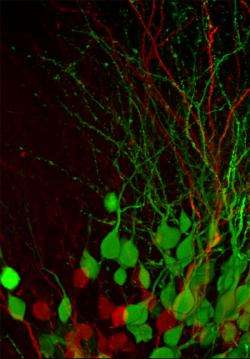
The researchers’ first task was to figure out a way to distinguish between pup-born and adult-born neurons in brain tissue that contained both. To accomplish that task, they used retroviruses to introduce one kind of fluorescent protein into the developing neurons and a second protein into the adult mouse brain. As a result of this treatment, the pup-born cells fluoresced green and the adult-born cells fluoresced red, making them readily distinguishable in brain slices.
Once they could tell the two types of cells apart, the researchers gained insight into the connections formed. They looked at glutamatergic (excitatory) nerves connecting the hippocampus with the entorhinal cortex, another brain area associated with memory. When they stimulated the excitatory inputs carrying information from the neocortex to the hippocampus, the researchers evoked similar responses in both pup-born and adult-born neurons.
Moreover, both cell types responded in the same dynamic manner to the stimulation, suggesting their ability to undergo synaptic plasticity is similar. Next, the researchers looked at GABAergic (inhibitory) inputs from interneurons that connect to the body and dendrites of the hippocampal neurons. Again, they see the responses are similar in frequency, amplitude, and kinetics between the pup-born and adult-born cells.
Having shown that pup-born and adult-born neurons respond to both excitatory and inhibitory inputs in the same way, the researchers next turned their attention to how the two types of cells integrate the signals from the various inputs to produce an action potential, or spike (which leads to the communication of the signal to subsequent neurons). Spiking probability varied among neurons but was not distinguishable between the two cell types, further supporting the earlier indications that adult-born and pup-born neurons function in fundamentally the same way.
Given the functional similarities between adult-born and pup-born neurons, this means that at least some neurons that develop in adult brains can form connections that are indistinguishable from connections formed by neurons that develop early in life—a hopeful finding for those who have set their sights on one day being able to repair damaged or deteriorated brain tissue.
Citation: Laplagne DA, Espo´ sito MS, Piatti VC, Morgenstern NA, Zhao C, et al. (2006) Functional convergence of neurons generated in the developing and adult hippocampus.
PLoS Biol 4(12): e409. DOI: 10.1371/journal.pbio.0040409. (dx.doi.org/10.1371/journal.pbio.0040409)
Source: Public Library Of Science


