Humans and chimpanzees, how similar are we?
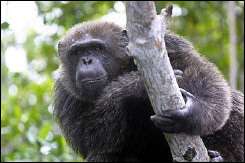
The DNA sequences of humans and chimpanzees are 98.5 percent identical, but now Uppsala University researchers can show that parts of the genetic material are missing in one species or the other.
This means in some cases that humans can produce a protein that the chimpanzee lacks and vice versa. The study, being published in the November issue of the Journal of Molecular Evolution, estimates that the total variation between humans and chimpanzees is rather 6–7 percent.
The chimpanzee, together with the pygmy chimpanzee (the bonobo), is the closest relative to humans still in existence. Even though the similarities between chimpanzees and human are obvious, there are clear differences in body structure, intellect, and behavior, etc. In the more than five million years that have passed since the developmental lines of humans and chimpanzees parted, mutations have altered the genes. A key issue for researchers studying the evolutionary history of humans and chimpanzees is to understand which of these differences have been crucial to the development of the species and their unique characteristics.
Tomas Bergström and his research team at the Department of Genetics and Pathology have compared the DNA sequence from chromosome 21 in humans and chimpanzees to map where the genetic differences are found and what significance this might have. The findings corroborate other studies that indicate that in 1.5 percent of the genetic material a nucleotide (genetic letter) has been replaced by another nucleotide. But the findings also show that more than 5 percent of the genetic material occurs in only one of the species. In both species, DNA has been added or lost. In other words, the total difference is estimated at 6.5 percent. Even though most of the differences occur, as expected, in parts of the genetic material that do not contain genes, the research team has found that pieces of DNA have been added or lost in 13 percent of the genes. Some genes (5 percent) have undergone such major changes that certain proteins can probably not be produced by one of the species.
“It is probable that a species can compensate for this by producing a similar protein from another part of the gene, but some of these differences have clearly been crucial to the development of the species,” says Tomas Bergström.
Source: Uppsala Universitet


