Magnetic fields revealed in technicolour
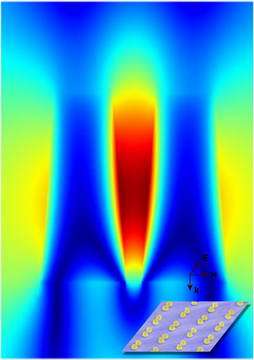
Vibrations of magnetization have for the first time been captured on camera by scientists at The University of Manchester revealing a rainbow of colours.
For the first time, images of induced magnetic pulsations at the frequency of visible light have been captured - as reported in Nature (17 November, 2005).
The colours are produced when a new type of material, created by the research team, is exposed to light. The magnetic vibrations induced in the material are so strong that they change the colour of the material from yellow to green. Such vibrations are supposed to be impossible in a natural medium.
The artificial material, created in collaboration with Chernogolovka Institute of Microelectronics Technologies (Russia) and Aston University (UK), has 'unnatural' optical properties and could be the precursor of a 'perfect lens', focusing images to show features smaller than the wavelength of light itself. It is based on Professor John Pendry's (Imperial College London) idea of generating the magnetic response in nonmagnetic composites.
Dr Alexander Grigorenko, of the University's School of Physics and Astronomy and Manchester Centre for Mesoscience and Nanotechnology, who led the research, said: "This discovery could be a milestone for optics and could help to realise the visible-light left-handed materials which promise the perfect lens. It also provides wherewithal for making new optical devices such as spasers and nanolasers."
The nanofabricated material was created by covering a glass plate with pairs of tiny gold pillars, each about 100 nanometres high. It was found that as light interacts with the structures, the induced currents create magnetic vibrations inside the pillar pairs and alter reflection properties, unlike a normal piece of gold. The research shows that negative permeability - a necessary condition for achieving a left-handed material - is indeed possible for visible light waves.
Dr Igor Khrushchev of Aston University, a specialist in optoelectronics, added: "The proposed structures could enjoy a variety of applications in optoelectronics and serve as optical signal processors, modulators, selective filters and antireflection coatings."
Potential applications of the materials and their unique properties include: smaller and smarter optical lenses, miniature lasers that can be built in computer chips and ultra-sensitive chemical and bio-detectors.
Source: University of Manchester
-
New nanostructure for batteries keeps going and going,
28 comments
-
Penn astrophysicists zero in on gravity theory,
202 comments
-
Engineer thinks we could build a real starship enterprise in 20 years,
49 comments
-
Sugar makes you stupid: Study shows high-fructose diet sabotages learning, memory,
13 comments
-
Brain oscillations reveal that our senses do not experience the world continuously,
10 comments
More news stories
Electronic congestion in the microchips of the future
(Phys.org) -- Electrons within some materials can stick together like cars on a traffic jam. Swiss researchers studying promising materials for the future of electronics have been able to highlight this phenomenon
4 hours ago |
5 / 5 (2) |
0
|
Graphite enters different states of matter
(Phys.org) -- For the first time, scientists have seen an X-ray-irradiated mineral go to two different states of matter in about 40 femtoseconds (a femtosecond is one quadrillionth of a second).
5 hours ago |
not rated yet |
0
|
NIST hydrogen fuel materials test facility starts delivering data
(Phys.org) -- Researchers at the National Institute of Standards and Technology (NIST) have published their first archival paper based on data from the institutes new hydrogen test facility. The paper ...
6 hours ago |
5 / 5 (1) |
0
Make or break for cellular tissues
In a study about to be published in the European Physical Journal E, French physicists from the Curie Institute in Paris have demonstrated that the behaviour of a thin layer of cells in contact with an unfavourable substr ...
5 hours ago |
not rated yet |
0
Towards hybrid quantum systems
EU-funded scientists made advances in the development of a hybrid quantum system (HQS) by combining different quantum technologies.
5 hours ago |
4 / 5 (1) |
0
IPhone to get larger screen: A report to take with a grain of salt?
Apple has begun preparing to launch an iPhone with a larger screen than its previous models, according to a report in the Wall Street Journal.
Healthy eating can cost less, study finds
Is it really more expensive to eat healthy? An Agriculture Department study released Wednesday found that most fruits, vegetables and other healthy foods cost less than foods high in fat, sugar and salt.
"Social Network" writer to pen Steve Jobs film script
Sony Pictures Entertainment on Wednesday said that the Academy Award winning screenwriter behind "The Social Network" will write the script for a film about Apple co-founder Steve Jobs.
NY tech fest heralds Silicon Valley of the East
The Big Apple may not have California's weather, but tech fans at New York Internet Week say that in every other way the city is on course to become Silicon Valley 2.0.
How do consumers achieve self-affirmation when purchasing products?
People who feel good about themselves are less likely to choose an attractive product than a functional one, according to a new study in the Journal of Consumer Research. But choosing highly aesthetic products may make p ...
Why do consumers dislike corporate brands that get too familiar?
Although it is tempting to use the word "we" to make consumers feel like part of the family, people react negatively when brands overstep their boundaries, according to a new study in the Journal of Consumer Research.