New Flying Wing Design Tested
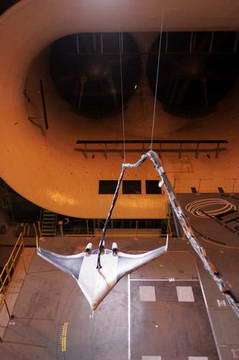
For almost a hundred years most planes have looked like a tube with wings, but that may change thanks to NASA research. Engineers at NASA's Langley Research Center in Hampton, Va., are testing a design for a flying wing, called a blended wing body or BWB, which would be more fuel efficient and environmentally friendly than today's aircraft.
Image: Scale model of a blended wing aircraft.
Technicians installed a five percent scale model of a BWB in the Langley Full-Scale Tunnel, owned by NASA Langley and operated by Old Dominion University in Norfolk, Va.
"It has a 12-foot wing span and we basically fly the model in the wind tunnel," said Dan Vicroy, senior research engineer at NASA Langley. "The test technique is called free flight where we actually have control systems on board the model as well as high pressure air that we use to simulate the engines."
It takes three pilots to fly the model during the free flight test, plus technicians and the test director. One pilot controls yaw and roll or the side-to-side motion. Another controls pitch or up and down. The third handles thrust or forward and back. Most of them sit in a control room perched high atop the huge 30-by-60 foot tunnel test section. That's where the model flies constrained only by a tether cable.
The purpose of the free flight test is to help engineers better understand how well the BWB handles since it doesn't have a tail to help control it like conventional aircraft do.
"We have a lot of experience with conventional what we call tube and wing airplanes," said Vicroy. "We know how to predict how they're going to fly. But with this type of a flying wing type design we really have very limited experience. When you get rid of the tail you have to come up with different ways to control it and that's part of what we're trying to test."
The blended wing body model has a whole series of control surfaces along the trailing edges of the wing, 18 in all. Researchers say most airplanes have about four: the rudder, the ailerons, the elevator and the flap. One of the challenges to controlling a flying wing, according to engineers, is determining how to blend the control surfaces to make the vehicle turn correctly or to pitch up and climb. NASA engineers say the BWB model flew quite easily, which may bode well for its future as a new aircraft design.
But other questions need to be answered before the BWB could be safely introduced as a transport aircraft. One is how to build a lightweight structure that can be pressurized. Scientists say it's easy to pressurize a tube, but not so easy to pressurize a non-cylindrical shape.
NASA is working with Boeing Phantom Works, Long Beach, Calif., on this advanced airplane concept. Researchers say a blended wing body could be useful as a multi-role aircraft for the military, including functioning as a tanker, cargo or transport plane.
Source: NASA


