Spirit's 'Everest' Panorama
Nov 08, 2005
Spirit's 'Everest' Panorama

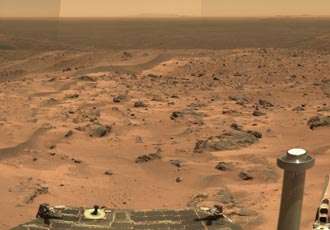
If a human with perfect vision donned a spacesuit and stepped onto the martian surface, the view would be as clear as this sweeping panorama taken by NASA's Mars Exploration Rover Spirit.

That's because the rover's panoramic camera has the equivalent of 20-20 vision. Earthlings can take a virtual tour of the scenery by zooming in on their computer screens many times to get a closer look at, say, a rock outcrop or a sand drift, without losing any detail. This level of clarity is unequaled in the history of Mars exploration.

Click here for full version of Spirit's 'Everest' panorama.

It took Spirit three days, sols 620 to 622 (Oct. 1 to Oct. 3, 2005), to acquire all the images combined into this mosaic, called the "Everest Panorama," looking outward in every direction from the true summit of "Husband Hill." During that period, the sky changed in color and brightness due to atmospheric dust variations, as shown in contrasting sections of this mosaic. Haze occasionally obscured the view of the hills on the distant rim of Gusev Crater 80 kilometers (50 miles) away.

As dust devils swooped across the horizon in the upper right portion of the panorama, the robotic explorer changed the filters on the camera from red to green to blue, making the dust devils appear red, green, and blue. In reality, the dust devils are similar in color to the reddish-brown soils of Mars. No attempt was made to "smooth" the sky in this mosaic, as has been done in other panoramic-camera mosaics to simulate the view one would get by taking in the landscape all at once. The result is a sweeping vista that allows viewers to observe weather changes on Mars.

The summit of Husband Hill is a broad plateau of rock outcrops and windblown drifts about 100 meters (300 feet) higher than the surrounding plains of Gusev Crater. In the distance, near the center of the mosaic, is the "South Basin," the destination for the downhill travel Spirit began after exploring the summit region.

This panorama spans 360 degrees and consists of images obtained during 81 individual pointings of the panoramic camera. Four filters were used at each pointing. Images through three of the filters, for wavelengths of 750 nanometers, 530 nanometers and 430 nanometers, were combined for this approximately true-color rendering.

Image credit: NASA/JPL-Caltech/Cornell

Explore further: Galaxy's Ring of Fire

add to favorites email to friend print save as pdf

Related Stories

Opportunity runs the first martian marathon

Jul 19, 2012

With all the fanfare about Mars rover Curiosity landing on the Red Planet in August 2012, it’s easy to forget that there’s already a rover on Mars—an older, smaller cousin set to accomplish ...

'Greeley Haven' is winter workplace for Mars rover

Jan 06, 2012

(PhysOrg.com) -- NASA's Mars Exploration Rover Opportunity will spend the next several months at a site informally named "Greeley Haven." The name is a tribute to planetary geologist Ronald Greeley (1939-2011), ...

Recommended for you

Galaxy's Ring of Fire

9 hours ago

Johnny Cash may have preferred this galaxy's burning ring of fire to the one he sang about falling into in his popular song. The "starburst ring" seen at center in red and yellow hues is not the product of ...

Mars rover Opportunity examines clay clues in rock

15 hours ago

(Phys.org) —NASA's senior Mars rover, Opportunity, is driving to a new study area after a dramatic finish to 20 months on "Cape York" with examination of a rock intensely altered by water.

Chinese, Indian airlines face EU pollution fines

19 hours ago

Eight Chinese and two Indian airlines face fines of up to several million euros for not paying for their greenhouse gas emissions during flights within the bloc, the European Commission said on Friday.

Alaska volcano shoots ash 15,000 feet into the air

19 hours ago

(AP)—One of Alaska's most restless volcanoes has shot an ash cloud 15,000 feet into the air in an ongoing eruption that has drawn attention from a nearby community but isn't expected to threaten air traffic.

NASA's STEREO detects a CME from the sun

May 17, 2013

On 5:24 a.m. EDT on May 17, 2013, the sun erupted with an Earth-directed coronal mass ejection or CME, a solar phenomenon that can send billions of tons of solar particles into space that can reach Earth ...

User comments : 0

More news stories

Galaxy's Ring of Fire

Johnny Cash may have preferred this galaxy's burning ring of fire to the one he sang about falling into in his popular song. The "starburst ring" seen at center in red and yellow hues is not the product of ...

Alaska volcano shoots ash 15,000 feet into the air

(AP)—One of Alaska's most restless volcanoes has shot an ash cloud 15,000 feet into the air in an ongoing eruption that has drawn attention from a nearby community but isn't expected to threaten air traffic.

Chinese, Indian airlines face EU pollution fines

Eight Chinese and two Indian airlines face fines of up to several million euros for not paying for their greenhouse gas emissions during flights within the bloc, the European Commission said on Friday.

Morocco to harness the wind in energy hunt

Morocco is ploughing ahead with a programme to boost wind energy production, particularly in the southern Tarfaya region, where Africa's largest wind farm is set to open in 2014.

US seizes Bitcoin operator accounts

US authorities seized the accounts of a Bitcoin digital currency exchange operator, claiming it was functioning as an "unlicensed money service business," court documents showed Friday.