Who’s in first? Physicists develop new football ranking system
Physicists at the University of Michigan devised a new way to rank college football teams that is fast and can be easily understood by fans.
Mark Newman, associate professor of physics, and doctoral student Juyong Park, a rabid Wolverine fan, based the new system on the mathematics of networks. It agrees largely with the results of the current oft-criticized Bowl Championship Series (BCS) system used to rank college football for recent seasons. However, it differs in several key, controversial cases, said Newman, who isn’t a football fan, and admits he’s even passed on tickets to the Big House.
The controversy in the BCS rankings arises because in a single season, not all teams play one another and because the results of different games can be contradictory, Newman said. To arrive at a set of rankings, the current BCS system combines two human polls and four computer algorithms, with the top two teams in the rankings taking part in the final post-season Bowl championship game.
Some details of the methodology behind the system have never been revealed to fans, which is frustrating, he said, and even more so when disagreement arises over the rankings and who plays in the championship game. For instance, this year, five teams -- UCLA, USC, Texas, Virginia Tech, and Alabama -- remain unbeaten, so which is the best?
According to the U-M method, rankings are: Texas (1); Virginia Tech (3); Alabama (5); USC (6) and UCLA (7).
To test their algorithm, Newman and Park compared all of the top teams ranked by BCS since inception.
“Overall we agreed quite closely with standard rankings, especially at the top,” Newman said. “In cases where we differed we found we agreed more closely with the computer polls than with the human judges.
“What we like about our method is it’s very simple,” Newman said. “The fans would like to understand how the selection is made.”
According to the U-M formula, if A beats B, and B beats C, then A also beats C. The U-M system automatically takes into account strength of the schedule, with teams getting direct wins by beating a team, and indirect wins by beating a team that beat another team.
“A real wins gets you the most and an indirect win is one step removed and gets you less and so forth,” Newman said. The ranking is based on the sum of the direct and indirect wins, and can be used at the beginning or the end of the season, or throughout.
“We found a rule of thumb which allows you to figure out how much to discount indirect wins which allows you to make evaluations of the season as the season progresses,” Newman said. “Once you have the schedule of games set, you can choose a value of an indirect win.”
Newman and Park also calculated the current season’s rankings.
“In this ranking, Big Ten teams are doing quite well, while Southern California, supposedly the strongest team right now, is ranked lower than other polls,” said Park. “We're only in the middle of the season and we will have to see how everything plays out toward the end, but I find that still interesting because Southern California and the rest of the Pac-10 conference are really thought to have a pretty weak schedule, while Big Ten teams are the opposite.
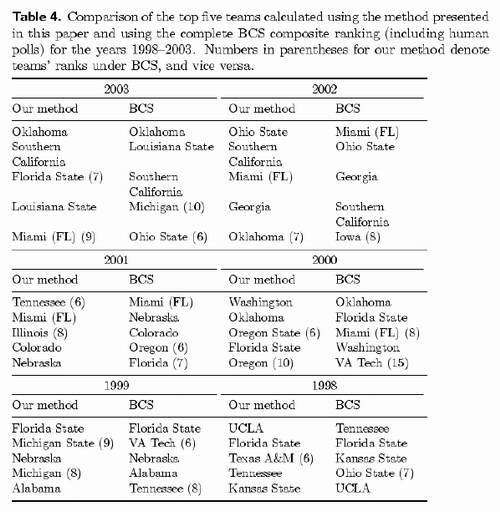
Image: A chart that compares BCS with U-M calculations, and a chart calculating this year’s ranking based on the U-M method.
“We also see that Michigan has apparently gotten some boost from beating Penn State (#2), but maybe not too much damage from being beaten by Wisconsin (#4), Notre Dame (#22), and Minnesota (#19), all top 25 teams,” Park said. “This is precisely how our method works -- winning against a strong opponent helps you a lot, but losing against a strong opponent doesn't hurt too much (of course winning would be much better).
For information on Newman, see: www.physics.lsa.umich.edu/depa … ctory/bio.asp?ID=802
Paper: www.iop.org/EJ/abstract/1742-5468/2005/10/P10014
Source: University of Michigan (by Laura Bailey)


