October 20, 2005 feature
Scientists build world's first single-molecule car
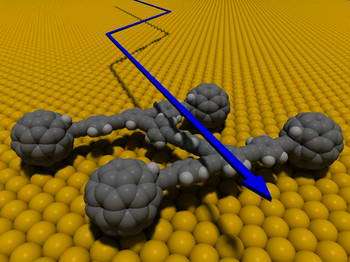
Rice University Scientists have done it. After BMW announced the possibility of producing a car that would utilize nanotechnology practically for all functions, Rice University scientists developed the world’s first single-molecule car- the car that was driven on a gold microscopic highway. It a small coupe that is devoid of any plush seating or conventional steering system. But it is a real solution for the grid locked cities. With a wheelbase of less than 5 nm, parking it is a cakewalk.
Image credit: Y. Shira/Rice University
According to Professor Tour this development is a watershed in so far as constructing successfully a nanocar represents the first step toward molecular manufacturing. Professor Tour avers: “It’s the beginning of learning how to manipulate things at the nanolevel in nonbiological systems.”
The nanocar consists of a chassis and axles made of well-defined organic groups with pivoting suspension and freely rotating axles. The wheels are buckyballs, spheres of pure carbon containing 60 atoms apiece. The entire car measures just 3-4 nanometers across, making it slightly wider than a strand of DNA. A human hair, by comparison, is about 80,000 nanometers in diameter.
When the project was initiated, the team was able to assemble the chassis and axles in just six months. But the fixing of the fullerene wheels proved far a more difficult task to be completed. It was primarily because according to the scientists the material to be used -fullerenes - shut down reactions mediated by transition-metal catalysts.
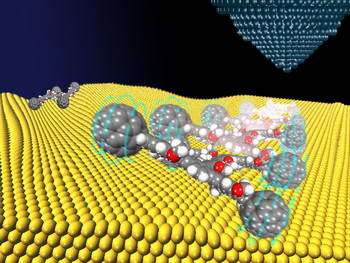
Ultimately the team decided to synthesize the axle and chassis via palladium-catalyzed coupling reactions. Attaching the wheels had to be the last step of the synthesis, but getting four fullerenes onto the molecule in sufficiently high yield was not a trivial task.
They found the nanocar was quite stable on the surface remaining parked until the surface was heated above 170 °C - presumably because of strong adhesion between the fullerene wheels and the underlying gold. Flat gold surface was used to prevent the nanocar actually roll around on its fullerene wheels, rather than slip like a car on ice. Between 170 °C and 225 °C, the researchers observed that the nanocar moved around by translational motion and pivoting. The translational motion was always in a direction perpendicular to the handcar’s axle, indicating that it moves by rolling rather than sliding.
Placing an STM tip in front of the car and pulling it forward control the movement of an individual car. The group subsequently built a nanotruck that can transport molecular cargo as well as a light-driven motorized nanocar. The development bodes opening new vistas.
Dr. Bikram Lamba, an international management consultant, is Chairman & Managing Director of Tormacon Limited- a multi-disciplinary consultancy organization. He can be contacted at 905 848 4205. Email: torconsult@rogers.com, site: www.torconsult.com.
By Bikram Lamba, Copyright 2005 PhysOrg.com
Source: Rice University
