Ultrafast lasers take 'snapshots' as atoms collide
Oct 20, 2005
Ultrafast lasers take 'snapshots' as atoms collide

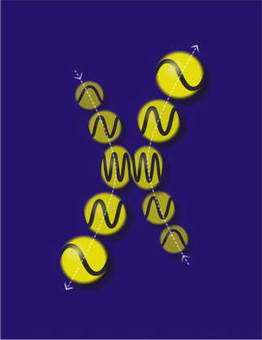
Using laser pulses that last just 70 femtoseconds (quadrillionths of a second), physicists have observed in greater detail than ever before what happens when atoms collide. The experiments at JILA, a joint institute of the National Institute of Standards and Technology (NIST) and the University of Colorado at Boulder, confirm a decades-old theory of how atoms--like tennis balls--briefly lose form and energy when they hit something. The results will help scientists study other atomic-scale processes and better understand the laws of physics.

Image: JILA scientists used brief flashes of laser light to reveal how atoms, like tennis balls, briefly lose form and energy when they collide. Image credit: V. Lorenz, JILA

The new data, reported in the Oct. 14 issue of Physical Review Letters,* provide the equivalent of missing frames in movies of colliding atoms (see simulated images in accompanying graphic). As is the case when a tennis ball is hit by a racquet, the motion is too quick for the eye but can be detected using short flashes of light. The JILA scientists collected data on atoms' properties before, during and after collisions lasting just half a picosecond (trillionth of a second) using laser "flashes" that were even faster.

In the JILA experiments, about 10 quintillion potassium atoms in a dense gas were packed into a titanium container just 1 square centimeter in size and heated to 700 degrees C (almost 1,300 degrees F). With such high temperatures and large numbers of atoms, the experiment is designed to maximize the number of atom collisions. Rapidly alternating pulses of laser light then are used to "freeze frame" the action.

Energy from the first laser pulse is absorbed by the atoms, placing them in a uniform state, emitting electromagnetic waves in identical patterns. A second laser then quickly hits the mass of atoms, and a detector captures a signal beam formed by the interaction of the beams. Light from the second pulse is absorbed and re-emitted by atoms that are "in synch" but not by atoms that are colliding and losing energy. The intensity of this signal beam, measured as a function of the delay between the two pulses, provides a "snapshot" of how many atoms are colliding at any one time, as well as details about changes in their wave patterns.

*V.O. Lorenz and S.T. Cundiff. 2005. Non-Markovian dynamics in a dense potassium vapor. Physical Review Letters. Oct. 14.

Source: NIST

Explore further: Engineers pioneer flat spray-on optical lens

add to favorites email to friend print save as pdf

Related Stories

JILA's instrument shop features innovation and precision

Jul 06, 2012

In the late 1980s, scientists in a JILA lab on the CU-Boulder campus were trying to create a new form of matter at what would be the coldest temperature in the universe. To reach such an unimaginable temperature, ...

Recommended for you

A quantum simulator for magnetic materials

1 hour ago

Physicists understand perfectly well why a fridge magnet sticks to certain metallic surfaces. But there are more exotic forms of magnetism whose properties remain unclear, despite decades of intense research. ...

Engineers pioneer flat spray-on optical lens

4 hours ago

A University of British Columbia engineer and a team of U.S. researchers have made a breakthrough utilizing spray-on technology that could revolutionize the way optical lenses are made and used.

Researchers forward quest for quantum computing

6 hours ago

Research teams from UW-Milwaukee and the University of York investigating the properties of ultra-thin films of new materials are helping bring quantum computing one step closer to reality.

How do cold ions slide

6 hours ago

Things not always run smoothly. It may happen, actually, that when an object slides on another, the advancement may occur through a 'stop and go' series in the characteristic manner which scientists call ...

User comments : 0

More news stories

A quantum simulator for magnetic materials

Physicists understand perfectly well why a fridge magnet sticks to certain metallic surfaces. But there are more exotic forms of magnetism whose properties remain unclear, despite decades of intense research. ...

Engineers pioneer flat spray-on optical lens

A University of British Columbia engineer and a team of U.S. researchers have made a breakthrough utilizing spray-on technology that could revolutionize the way optical lenses are made and used.

Researchers forward quest for quantum computing

Research teams from UW-Milwaukee and the University of York investigating the properties of ultra-thin films of new materials are helping bring quantum computing one step closer to reality.

How do cold ions slide

Things not always run smoothly. It may happen, actually, that when an object slides on another, the advancement may occur through a 'stop and go' series in the characteristic manner which scientists call ...