Honeybee brain picks up on right scent
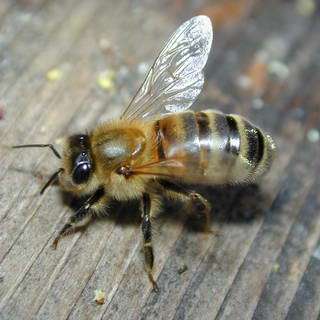
A honeybee’s ability to smell scent appears to be linked to the right side of its brain, according to a new ANU study that could show how right and left ‘handedness’ evolved in other species.
“Just as humans use different brain hemispheres for different tasks, it appears honeybees and other insect species may also be right or left ‘brained’ for certain activities,” PhD student Pinar Letzkus from the ANU Research School of Biological Sciences said.
In the study, Ms Letzkus and colleagues found that honeybees use their right antenna to learn and recognise scent using three groups of bees in special smell learning exercises: one group had their left antenna covered, another group their right antenna covered, while the control group had neither antenna covered.
“The group with their left antenna covered – that is, the ones using their right antenna to pick up a scent added to sugar water – were just as competent at learning to recognise the scent as the control group, but the group with their right antenna covered were poorer at learning to recognise the smell of the sugar water.
“The results indicate that the right antenna in the honeybee is crucial in learning to recognise scent, suggesting that bees are right-brained when it comes to smell.”
The study, published in the journal Current Biology, is the first time that a right/left tendency for odour recognition has been shown in creatures such as insects, which have small and relatively simple brains.
“It is well known that the two hemispheres of the human brain are functionally specialised in that certain skills, such as language, musical ability and emotional responses, are mediated more by one hemisphere than the other,” ANU Visual Sciences Professor Mandyam Srinivasan said.
“Studies over the past 30 years suggest that brain lateralisation occurs in other vertebrate species as well, but little is known about functional asymmetry in invertebrates, like bees.
“This research shows for the first time that such asymmetries extend to insects as well. It’s an intriguing finding.”
Ms Letzkus said the results could shed light on brain physiology and evolution more generally.
“But there is still much to be answered. One of the biggest questions is whether this system of left/right demarcation has evolved separately in insects and mammals, or whether it’s a primitive system that for some reason has been genetically conserved in the evolutionary process.”
Ms Letzkus will next explore whether there is any difference in the sensitivity of the left and right antenna of bees.
Source: Australian National University


