Single-Molecule Chemical-Field-Effect Transistor with Nanometer-Sized Gates
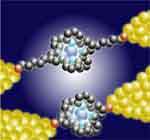
F. Jackel and group of scientists from Max-Planck-Institute and Humboldt University Berlin, Germany present a prototypical single-molecule chemical-field-effect transistor, in which the current through a hybrid-molecular diode is modified by nanometer-sized charge transfer complexes covalently linked to a molecule in an STM junction. Their article is published in the last Physical Review Letters issue ( vol. 92, no. 18 )
The semiconductor industry has seen a remarkable miniaturization trend, driven by many scientific and technological innovations. But if this trend is to continue, and provide ever faster and cheaper computers, the size of microelectronic circuit components will soon need to reach the scale of atoms or molecules—a goal that will require conceptually new device structures. The idea that a few molecules, or even a single molecule, could be embedded between electrodes and perform the basic functions of digital electronics—rectification, amplification and storage—was first put forward in the mid-1970s. The concept is now realized for individual components, but the economic fabrication of complete circuits at the molecular level remains challenging because of the difficulty of connecting molecules to one another. A possible solution to this problem is 'mono-molecular' electronics, in which a single molecule will integrate the elementary functions and interconnections required for computation.
Transistors, traditionally made from silicon, regulate the transmission of electrons across barriers. The barrier height, and hence the electron flow, can be controlled by applying a small voltage to an electrode that acts as a gate.
A single molecule with a donor–spacer–acceptor structure behaves as a diode when placed between two electrodes: electrons can easily flow from the cathode to the acceptor, and electrons from the donor are then transferred to the anode. The working principle of this device is analogous to that underlying the "valve" effect introduced by Schockley 60 years ago, but involves manipulating the electronic wavefunction of the metallic electrodes extending through the donor–spacer–acceptor molecule, rather than the carrier density in a semiconductor material.
Scanning tunnelling microscope enables controlled two-terminal measurements, and its development has thus allowed new experimental approaches for demonstrating and probing electron transport through individual molecules.
Nanolithography has made important contributions towards using mesoscopic electrodes and nanojunctions for hybrid molecular electronics.
Field effect transistors have been fabricated with carbon nanotubes and single molecules. The electrodes, however, were macro- or mesoscopic and not readily scalable to nanoscale dimensions.
Authors present a prototypical three-terminal device at the solid-liquid inter-face, in which the current through a hybrid-molecular diode is modified by nanometer-sized charge transfer complexes (‘‘nanogates’’) covalently linked to the mole-cule in the STM junction.
They regarded this proof of principle as a major step towards monomolecular electronic devices and highly sensitive electronic molecular probes.


