Earthquake Study Suggests Simple Building Fixes Can Save Lives
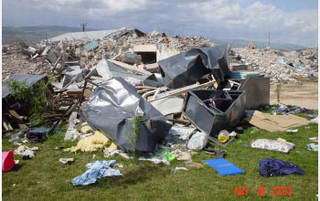
According to a recent report, a small number of reinforced concrete walls would have been sufficient to keep schools, dormitories and other buildings standing after the 2003 earthquake in Bingöl, Turkey. An American-Turkish team of engineers said many of the 168 deaths could have been prevented had builders followed Turkey's existing structural codes.
Image: In the foreground lie the remains of steel lockers and beds, amidst other debris, from Celtiksuyu Boarding School. The school was devastated by the May 2003 earthquake in Bingol, Turkey. Credit: William A. Mitchell, Earthquake Engineering Research Institute (EERI)
Led by Purdue University civil engineering professors Julio Ramirez and Mete Sozen, the NSF-supported research team presented their findings at the 13th World Conference on Earthquake Engineering in 2004 and published their findings this past summer in the Canadian Association for Earthquake Engineering newsletter.
The researchers found that many of the failed buildings had "captive columns," slender, reinforced-concrete pillars that stand at the ends of shorter walls. The engineers consider the structures to be a "fundamental and classic" flaw -- when a quake strikes, the portion of the column above the wall is unsupported and receives the full brunt of seismic forces.
After each column breaks, the building's weight is held by fewer and fewer of these pillars, resulting in a domino effect. Had supporting walls been present, the pillars would not have moved as violently from side to side, and the walls would have supported some of the overlying load. That simple fix could have prevented the collapse of the school buildings.
The researchers, sponsored by the National Science Foundation (NSF) and TUBITAK, the NSF counterpart in Turkey, made their report available to Turkish officials. The researchers hope their report on the damage from the 6.4 magnitude quake will help influence construction practices.
While relatively few building modifications would be needed to upgrade existing buildings, researchers fear that the same scenario could play out again in Turkey, the Caribbean, Latin America and elsewhere if officials do not enforce codes more strictly.
Source: NSF
-
From lemons to lemonade: Reaction uses carbon dioxide to make carbon-based semiconductor,
33 comments
-
Thioridazine kills cancer stem cells in human while avoiding toxic side-effects of conventional cancer treatments,
3 comments
-
SpaceX private rocket blasts off for space station (Update),
42 comments
-
Landmark calculation clears the way to answering how matter is formed,
55 comments
-
Research team claims to have found evidence Lake Cheko is impact crater for Tunguska Event,
18 comments
More news stories
Change in developmental timing was crucial in the evolutionary shift from dinosaurs to birds: study
At first glance, it's hard to see how a common house sparrow and a Tyrannosaurus Rex might have anything in common. After all, one is a bird that weighs less than an ounce, and the other is a dinosaur that ...
Other Sciences / Archaeology & Fossils
11 hours ago |
5 / 5 (8) |
0
|
Social welfare cuts ultimately come with heavy price, researchers say
(Phys.org) -- Slashing government funding for Medicaid, food stamps and other programs that serve the poor while politically popular with some lawmakers and many conservatives may do more harm ...
Other Sciences / Social Sciences
May 24, 2012 |
4.1 / 5 (23) |
156
Ancient Bethlehem seal unearthed in Jerusalem
Israeli archaeologists have discovered a 2,700-year-old seal that bears the inscription "Bethlehem," the Israel Antiquities Authority announced Wednesday, in what experts believe to be the oldest artifact ...
Other Sciences / Archaeology & Fossils
May 23, 2012 |
3.3 / 5 (15) |
24
Dollars and sense: Why are some people morally against tax?
As the U.S. presidential election campaigns heat up, the economic debate is dominated by bailouts, austerity and, inevitably, taxation. Now a new study published in Symbolic Interaction asks why tax is such an important issue ...
Other Sciences / Social Sciences
May 23, 2012 |
2.3 / 5 (3) |
20
Oldest Jewish archaeological evidence on the Iberian Peninsula
German archaeologists of the Friedrich Schiller University Jena found one of the oldest archaeological evidence so far of Jewish Culture on the Iberian Peninsula at an excavation site in the south of Portugal, ...
Other Sciences / Archaeology & Fossils
May 25, 2012 |
4.2 / 5 (6) |
12
Stunning image of smallest possible five-ringed structure
Scientists have created and imaged the smallest possible five-ringed structure about 100,000 times thinner than a human hair and you'll probably recognise its shape.
'Unzipped' carbon nanotubes could help energize fuel cells, batteries
Multi-walled carbon nanotubes riddled with defects and impurities on the outside could replace some of the expensive platinum catalysts used in fuel cells and metal-air batteries, according to scientists at ...
Computer model used to pinpoint prime materials for efficient carbon capture
When power plants begin capturing their carbon emissions to reduce greenhouse gases and to most in the electric power industry, it's a question of when, not if it will be an expensive undertaking.
T cells 'hunt' parasites like animal predators seek prey, study shows
By pairing an intimate knowledge of immune-system function with a deep understanding of statistical physics, a cross-disciplinary team at the University of Pennsylvania has arrived at a surprising finding: T cells use a movement ...
Yale study concludes public apathy over climate change unrelated to science literacy
Are members of the public divided about climate change because they don't understand the science behind it? If Americans knew more basic science and were more proficient in technical reasoning, would public consensus match ...
Land and sea species differ in climate change response: study
(Phys.org) -- Marine and terrestrial species will likely differ in their responses to climate warming, new research by Simon Fraser University and Australia’s University of Tasmania has found.