One of Hubble Space Telescope Instruments is Broken
August 7, 2004

Hubble Space Telescope

Hubble Space Telescope

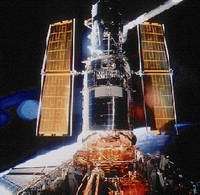
Hubble Space Telescope was originally designed in the 1970s and launched in 1990. Every day, Hubble archives 3 to 5 gigabytes of data and delivers between 10 and 15 gigabytes to astronomers all over the world. Now over 10 years old (launched in 1990), the telescope is basically a new machine. Upgrades and maintenance keep Hubble operating in top condition to give us the greatest scientific data possible.

Yesterday Nasa reported that one of four science instruments aboard NASA's Hubble's Space Telescope suspended operations earlier this week, and engineers are now looking into possible recovery options.

The instrument, called the Space Telescope Imaging Spectrograph (STIS), was installed during the second Hubble servicing mission in 1997 and was designed to operate for five years. It has either met or exceeded all its scientific requirements.

Hubble's other instruments, the Near Infrared Camera and Multi-Object Spectrometer (NICMOS), the Advanced Camera for Surveys, and the Wide Field/Planetary Camera 2 are all operating normally.

The STIS instrument, which went into a suspended mode Tuesday, was not slated for replacement or upgrade as part of any future servicing mission.

NASA has convened an Anomaly Review Board to investigate the cause of the STIS problem and an investigation is underway to determine if the instrument is recoverable.

Preliminary findings indicate a problem with the +5V DC-DC power converter on Side 2, which supplies power to the mechanism's electronics. STIS suffered a similar electrical malfunction in 2001 that rendered Side 1 inoperable.

A final decision on how to proceed is expected in the coming weeks as analysis of the problem progresses.

In the current observing cycle, STIS accounts for about 30 percent of all Hubble scientific observation programs. A "standby" list of peer reviewed and approved observing programs for the other science instruments on Hubble can be used to fill the observing time now available.

The high sensitivity and spatial resolution of STIS enabled astronomers to search for massive black holes and study star formation, planets, nebulae, galaxies, and other objects in fine detail.

STIS was developed jointly with Ball Aerospace under the direction of principal investigator Dr. Bruce E. Woodgate of the Laboratory for Astronomy and Solar Physics at NASA's Goddard Space Flight Center, Greenbelt, Md.

Among the major scientific achievements made by scientists using STIS were:

- Independent confirmation of the age of the universe by finding the coolest and hence oldest white dwarf stars that exist in our galaxy
- Conducted an efficient census of galaxies to catalog supermassive black holes. The fraction of galaxies that prove to contain a central massive black hole has proven to be surprisingly large
- Made the first-ever measurements of the chemical composition of the atmosphere of an extrasolar planet
- Saw the magnetic "footprints" of the Jovian satellites in Jupiter aurora, and made clear images of Saturn's aurora
- Studied the dynamics of circumstellar disks, the region around young stars where planets may form
- Found the first evidence of the high-speed collision of gas in the recent supernova remnant SN1987A

Additional information about STIS is available on the Internet at the Hubble Project Servicing Mission 2 web page.

Source: NASA


Rank not rated yet
Tags

Relevant PhysicsForums posts

More news stories

Yale study concludes public apathy over climate change unrelated to science literacy

Are members of the public divided about climate change because they don't understand the science behind it? If Americans knew more basic science and were more proficient in technical reasoning, would public consensus match ...

Space & Earth / Environment

created 11 hours ago | popularity 4.8 / 5 (6) | comments 27 | with audio podcast

Land and sea species differ in climate change response: study

(Phys.org) -- Marine and terrestrial species will likely differ in their responses to climate warming, new research by Simon Fraser University and Australia’s University of Tasmania has found.

Space & Earth / Environment

created 9 hours ago | popularity 4 / 5 (5) | comments 6 | with audio podcast

10 million years needed to recover from mass extinction

It took some 10 million years for Earth to recover from the greatest mass extinction of all time, latest research has revealed.

Space & Earth / Earth Sciences

created 11 hours ago | popularity 4.2 / 5 (5) | comments 2 | with audio podcast

Sophisticated simulations predict future warming

The chances of our planet being hit by a global warming of 3 degrees Celsius by 2050 is as likely as it being hit by an increase of 1.4 degrees, new research shows. Presented in the journal Nature Geoscience, the British study ...

Space & Earth / Earth Sciences

created May 22, 2012 | popularity 3.8 / 5 (11) | comments 51

Kyoto Protocol architect 'frustrated' by climate dialogue

UN climate talks are going nowhere, as politicians dither or bicker while the pace of warming dangerously speeds up, one of the architects of the Kyoto Protocol told AFP.

Space & Earth / Environment

created May 23, 2012 | popularity 3.4 / 5 (8) | comments 43


Stunning image of smallest possible five-ringed structure

Scientists have created and imaged the smallest possible five-ringed structure – about 100,000 times thinner than a human hair – and you'll probably recognise its shape.

'Unzipped' carbon nanotubes could help energize fuel cells, batteries

Multi-walled carbon nanotubes riddled with defects and impurities on the outside could replace some of the expensive platinum catalysts used in fuel cells and metal-air batteries, according to scientists at ...

Change in developmental timing was crucial in the evolutionary shift from dinosaurs to birds: study

At first glance, it's hard to see how a common house sparrow and a Tyrannosaurus Rex might have anything in common. After all, one is a bird that weighs less than an ounce, and the other is a dinosaur that ...

Computer model used to pinpoint prime materials for efficient carbon capture

When power plants begin capturing their carbon emissions to reduce greenhouse gases – and to most in the electric power industry, it's a question of when, not if – it will be an expensive undertaking.

T cells 'hunt' parasites like animal predators seek prey, study shows

By pairing an intimate knowledge of immune-system function with a deep understanding of statistical physics, a cross-disciplinary team at the University of Pennsylvania has arrived at a surprising finding: T cells use a movement ...

Browser wars flare in mobile space

The browser wars are heating up again, but this time the fight is for dominance of the mobile Internet.