Titan's Enigmatic Infrared-Bright Spot Is Surface Make-Up
Oct 06, 2005
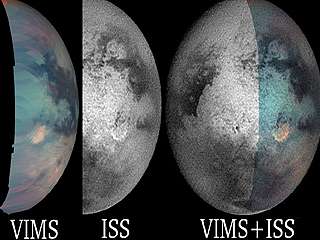
ombined VIMS and ISS images of Titan's mysterious bright red spot gives researchers more information about the feature than eith

A 300-mile-wide patch that outshines everything else on Titan at long infrared wavelengths appears not to be a mountain, a cloud or a geologically active hot spot, University of Arizona scientists and Cassini team members say.

Image: Combined VIMS and ISS images of Titan's mysterious bright red spot gives researchers more information about the feature than either single view. (Credit: NASA/JPL/University of Arizona/Space Science Institute)

"We must be looking at a difference in surface composition," said Jason W. Barnes, a postdoctoral researcher at UA's Lunar and Planetary Lab. "That's exciting because this is the first evidence that says not all of the bright areas on Titan are the same. Now we have to figure out what those differences are, what might have caused them."

When NASA's Cassini spacecraft flew by Titan on March 31 and again on April 16, its visual and infrared mapping spectrometer saw a feature that was spectacularly bright at 5-micron wavelengths just southeast of the continent-sized region called Xanadu.

The bright spot occurs where Cassini's visible-wavelength imaging cameras photographed a bright arc-shaped feature approximately the same size in December 2004 and February 2005.

Cassini's radar instrument, operating in the "passive" mode that is sensitive to microwaves emitted from a planetary surface, saw no temperature difference between the bright spot and surrounding region. That rules out the possibility that the 5-micron bright spot is a hot spot, such as a geologically active ice volcano, Barnes said.

Cassini microwave radiometry also failed to detect a temperature drop that would show up if some two-mile high mountain rose from Titan's surface, he said.

And if the 5-micron bright spot is a cloud, it's a cloud that hasn't moved or changed shape for three years, according to ground-based observations made at the Keck Telescope and with Cassini's visual and infrared mapping spectrometer during five different flybys. "If this is a cloud," Barnes said, "it would have to be a persistent ground fog, like San Francisco on steroids, always foggy, all the time."

"The bright spot must be a patch of surface with a composition different from anything we've seen yet. Titan's surface is primarily composed of ice. It could be that something is contaminating the ice here, but what this might be is not clear," Barnes said.

"There's a lot left to explore about Titan. It's a very complex, exciting place. It's not obvious how it works. It's going to be a lot of fun over the next couple of years figuring out how Titan works," he said.

Barnes and 34 other scientists report the research in the Oct. 7 issue of Science. Authors include UA Lunar and Planetary Laboratory scientists and Cassini team members Robert H. Brown, head of Cassini's visual and infrared mapping spectrometer team; Elizabeth P. Turtle and Alfred S. McEwen of the Cassini imaging team; Ralph D. Lorenz of the Cassini radar team; Caitlin Griffith of the Cassini visual and infrared mapping team; and Jason Perry and Stephanie Fussner, who work with McEwen and Turtle on Cassini imaging.

Source: University of Arizona

Explore further: Collisions of coronal mass ejections can be super-elastic

add to favorites email to friend print save as pdf

Related Stories

'Hot spots' ride a merry-go-round on Jupiter

Mar 14, 2013

(Phys.org) —In the swirling canopy of Jupiter's atmosphere, cloudless patches are so exceptional that the big ones get the special name "hot spots." Exactly how these clearings form and why they're only ...

Cassini watches storm choke on its own tail

Jan 31, 2013

(Phys.org)—Call it a Saturnian version of the Ouroboros, the mythical serpent that bites its own tail. In a new paper that provides the most detail yet about the life and death of a monstrous thunder-and-lightning ...

Cassini finds a video gamers' paradise at Saturn

Nov 26, 2012

(Phys.org)—You could call this "Pac-Man, the Sequel." Scientists with NASA's Cassini mission have spotted a second feature shaped like the 1980s video game icon in the Saturn system, this time on the moon ...

After-effects of Saturn's super storm shine on (w/ Video)

Oct 25, 2012

(Phys.org)—The heat-seeking capabilities of the international Cassini spacecraft and two ground-based telescopes have provided the first look at the aftermath of Saturn's 'Great Springtime Storm'. Concealed from the naked ...

The mystery of Venus’ ashen light

Apr 30, 2012

May is the best time to try and spot one of the most enduring unsolved mysteries in our Solar System. Ashen Light is a faint glow allegedly seen on the unlit portion of Venus, during its crescent phase, similar to the earthshine ...

STAR TRAK for February 2012

Feb 02, 2012

As evening twilight fades during February, the two brightest planets, Venus and Jupiter, will highlight the sky as they come into view in the southwest.

Recommended for you

Forecast for Titan: Wild weather could be ahead

3 hours ago

(Phys.org) —Saturn's moon Titan might be in for some wild weather as it heads into its spring and summer, if two new models are correct. Scientists think that as the seasons change in Titan's northern hemisphere, ...

NASA's Landsat satellite looks for a cloud-free view

3 hours ago

For decades, Landsat satellites have documented the desiccation of the Aral Sea in Central Asia. Once one of the largest seas in the world, it shrunk to a tenth of its original volume after Russia diverted ...

SDO observes mid-level solar flare

3 hours ago

UPDATE 16:30 p.m. EDT: The M7-class flare was also associated with a coronal mass ejection or CME, another solar phenomenon that can send billions of tons of particles into space. While this CME was not Ea ...

User comments : 0

More news stories

Forecast for Titan: Wild weather could be ahead

(Phys.org) —Saturn's moon Titan might be in for some wild weather as it heads into its spring and summer, if two new models are correct. Scientists think that as the seasons change in Titan's northern hemisphere, ...

SDO observes mid-level solar flare

UPDATE 16:30 p.m. EDT: The M7-class flare was also associated with a coronal mass ejection or CME, another solar phenomenon that can send billions of tons of particles into space. While this CME was not Ea ...

NASA's Landsat satellite looks for a cloud-free view

For decades, Landsat satellites have documented the desiccation of the Aral Sea in Central Asia. Once one of the largest seas in the world, it shrunk to a tenth of its original volume after Russia diverted ...