US 'space tourist' blasts off aboard Soyuz (update)
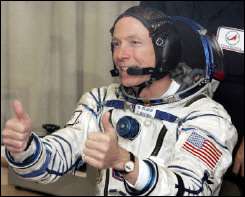
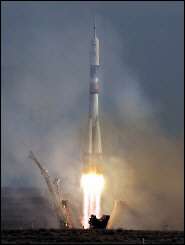
A Soyuz rocket blasted off from the Baikonur space centre in Kazakhstan early Saturday, taking American "space tourist" Greg Olsen and his fellow astronauts, a Russian and another American, off towards the International Space Station.
The rocket climbed faultlessly away from the Kazakh steppes carrying the Soyuz TMA-7 capsule and its fee-paying and professional crew.
Ten minutes later the capsule was placed in orbit, to the applause of the hundreds of people, including Olsen's family, crowded into an observation post within sight of the launching pad.
On Friday, 59-year-old grandfather Olsen confessed to a few pre-launch nerves ahead of his 20 million-dollar trip, the fulfillment of months of tough preparation.
"I'll be most relaxed and happy after the rocket takes off," said Olsen, speaking at the Baikonur space centre ahead of his launch.
Olsen was accompanied by Russian cosmonaut Valery Tokarev and US astronaut William McArthur on the trip to the ISS, where they will arrive on Monday, after a period in orbit adjusting to conditions of weightlessness.
Two other "space tourists" have preceded Olsen in what is becoming a profitable sideline for the Russian space programme: American Dennis Tito in 2001 and South African Mark Shuttleworth in 2002.
Despite the hefty price-tag, Olsen can expect few creature comforts aboard the Soyuz, a low-frills workhorse, or the space station.
He has also insisted there is a work component to his sojourn, as he plans to test out equipment developed by his company, a New Jersey-based firm that makes electronic sensors for military and civilian use.
He will also undertake medical experiments and take photographs.
After eight days in the ISS, he will leave his two crewmates and head back to earth with the space station's current occupants, Russian Sergei Krikalyov and American John Phillips.
Their capsule is due to bump down on the Kazakh steppe on October 11. Predicting the precise spot has in the past proved a hit-or-miss affair.
Olsen's family, including three sisters, his daughter, son-in-law and four-year-old grandson, all wearing inscribed blue jackets, cracked open the champagne as the capsule swung into orbit.
"The take-off was a great moment, I'm very excited and very nervous," said Krista Dibsie, Olsen's daughter.
"Before lift-off my father just told me that he loved me and slapped hands with his grandson."
Other spectators included local residents, relatives of the other crew of the Soyuz and Michael Griffin, head of the US space agency NASA.
Griffin warned Friday after talks with his Russian counterpart Valery Perminov that McArthur's six-month mission aboard the ISS could be the last for a US astronaut for some time.
US space shuttles are grounded following a continuing technical problem concerning the insulation of the booster rocket that caused the 2003 break-up of the shuttle Columbia and will not fly again before March 2006 at the earliest.
Flights for US astronauts aboard Russia's Soyuz are also blocked by new legislation aimed at preventing Iran obtaining nuclear technology, which will bar Washington from paying Moscow, currently building a nuclear power station for Tehran, the 65 million dollars the Russians are demanding for each trip.
"We have to negotiate an acceptable deal, an acceptable financial agreement with the Russian side," Griffin said.
Otherwise, if the US legislation is not amended, "We will not be able to have a continuous US presence on the station."
Negotiations are expected to start in Moscow on Thursday. Meanwhile, Alexei Krasnov, responsible for manned flights in the Russian space agency, said: "Formally, we are not even obliged to ensure the return of William McArthur in six months.
© 2005 AFP


