Preserving a 460 year old wreck
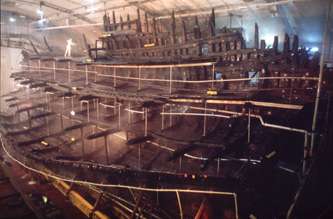
An international team of researchers has analysed the sulphur and iron composition in the wooden timbers of the Mary Rose, an English warship wrecked in 1545, which was salvaged two decades ago. The team used synchrotron X-rays from the Stanford Synchrotron Radiation Laboratory (USA) and the European Synchrotron Radiation Facility (France) in order to determine the chemical state of the surprisingly large quantities of sulphur and iron found in the ship.
These new results provide insight to the state of this historic vessel and should aid preservation efforts. They are published this week in the Proceedings of the National Academy of Sciences Early Edition.
The Mary Rose served as English King Henry VIII's principal warship for 35 years until she went down outside of Portsmouth in 1545. In 1982 the hull was recovered from the sea and is currently undergoing a conservation process. The first author of the publication, Magnus Sandström, and his colleagues showed recently that the accumulation of sulphur within shipwrecks preserved in seawater is common by studying the Swedish warship Vasa, which remained on the seabed for 333 years. Their research concluded that sulphur in contact with oxygen could pose conservation problems. Over time, sulphur can convert to sulphuric acid, which slowly degrades the wood until the hull's stability is lost.
The authors examined the Mary Rose to determine the potential threat and found about 2 tons of sulphur in different compounds rather uniformly distributed within the 280-ton hull. To determine the sulphur species present in the wood, researchers first carried out experiments at SSRL. The team needed to obtain complimentary information in order to know the precise location of sulphur species at the micron scale and they then came to the ESRF. By studying thin wood slices perpendicularly cut to the cell walls at X-ray microscopy beamline ID21, they found high concentrations of organo-sulphur compounds in the lignin-rich areas between the cells, which may have helped preserve the ship while it was submerged in the seawater. This helped to understand how accessible and reactive the different sulphur compounds found are to acid-producing oxidation.
Plenty of iron and pyrite is also present in the Mary Rose, which is a concern, since in the moist wood iron ions can catalyse the conversion of sulphur to sulphuric acid in the presence of oxygen. The authors suggest that chemical treatments to remove or stabilize the remaining iron and sulphur compounds, and reducing humidity and oxygen access, are requirements for long-term preservation.
At the Mary Rose Trust they are already investigating new treatments to prevent new acid formation. For slowing down the organo-sulphur oxidation reaction and prevent new acid formation, wood samples from the Mary Rose are being treated with antioxidants in combination with low and high grade polyethylene glycol (PEG). Another approach to slow down acid formation in PEG treated conserved archaeological wood is to maintain it in a stable climate. It is hoped that keeping a constant low humidity of 50-55% without variations of temperature will stop changes in sulphur speciation. To maintain a stable microclimate within the wood structure a surface coating offers a possible solution, although the effectiveness of this approach has yet to be tested. “This ongoing research is considered to be an important step forward in devising improvements to the current Mary Rose hull treatment programme”, explains Mark Jones, curator of the Mary Rose.
Source: ESRF
-
From lemons to lemonade: Reaction uses carbon dioxide to make carbon-based semiconductor,
33 comments
-
Thioridazine kills cancer stem cells in human while avoiding toxic side-effects of conventional cancer treatments,
3 comments
-
SpaceX private rocket blasts off for space station (Update),
42 comments
-
Landmark calculation clears the way to answering how matter is formed,
55 comments
-
Research team claims to have found evidence Lake Cheko is impact crater for Tunguska Event,
18 comments
More news stories
Is a classical electrodynamics law incompatible with special relativity?
(Phys.org) -- The laws of classical electromagnetism that were developed in the 19th century are the same laws that scientists use today. They include Maxwell’s four equations along with the Lorentz la ...
Landmark calculation clears the way to answering how matter is formed
(Phys.org) -- An international collaboration of scientists, including Thomas Blum, associate professor of physics, is reporting in landmark detail the decay process of a subatomic particle called a kaon ...
May 25, 2012 |
4.3 / 5 (24) |
55
|
Lying in wait for WIMPs: Researchers seek to dramatically increase sensitivity of Large Underground Xenon detector
Although it's invisible, dark matter accounts for at least 80 percent of the matter in the universe. No one knows what it is, but most scientists would bet on weakly interacting massive particles, or WIMPs.
May 23, 2012 |
4 / 5 (7) |
19
|
Hawaii lab turns laser-powered bubbles into microrobots
(Phys.org) -- A team of scientists from the University of Hawaii are working on microrobots created from bubbles of air in a saline solution. The bubbles take on their title of robots as a laser ...
Sound increases the efficiency of boiling
Scientists at the Georgia Institute of Technology achieved a 17-percent increase in boiling efficiency by using an acoustic field to enhance heat transfer. The acoustic field does this by efficiently removing vapor bubbles ...
May 24, 2012 |
5 / 5 (2) |
2
Stunning image of smallest possible five-ringed structure
Scientists have created and imaged the smallest possible five-ringed structure about 100,000 times thinner than a human hair and you'll probably recognise its shape.
'Unzipped' carbon nanotubes could help energize fuel cells, batteries
Multi-walled carbon nanotubes riddled with defects and impurities on the outside could replace some of the expensive platinum catalysts used in fuel cells and metal-air batteries, according to scientists at ...
Change in developmental timing was crucial in the evolutionary shift from dinosaurs to birds: study
At first glance, it's hard to see how a common house sparrow and a Tyrannosaurus Rex might have anything in common. After all, one is a bird that weighs less than an ounce, and the other is a dinosaur that ...
Computer model used to pinpoint prime materials for efficient carbon capture
When power plants begin capturing their carbon emissions to reduce greenhouse gases and to most in the electric power industry, it's a question of when, not if it will be an expensive undertaking.
T cells 'hunt' parasites like animal predators seek prey, study shows
By pairing an intimate knowledge of immune-system function with a deep understanding of statistical physics, a cross-disciplinary team at the University of Pennsylvania has arrived at a surprising finding: T cells use a movement ...
Yale study concludes public apathy over climate change unrelated to science literacy
Are members of the public divided about climate change because they don't understand the science behind it? If Americans knew more basic science and were more proficient in technical reasoning, would public consensus match ...