Sandia Researchers Use the Latest Innovations to Prevent Future Terrorist Attacks
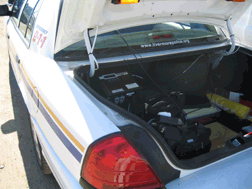
While some 15,000 Livermore residents and visitors enjoyed barbecues, music, picnics, and other Fourth of July festivities, Sandia National Laboratories researchers and their counterparts at the City of Livermore Police Department (LPD) were using the occasion to test a complex system of sensors and other advanced technology designed to keep revelers safe from future terrorist attacks.
No such threats were anticipated (nor experienced) at Livermore’s Robertson Park, which acted as the backdrop for the unique experiment. Still, Sandia researchers say the test deployment confirmed their hopes that the Sensor Management Architecture (SMA) system could serve an important and valuable role for regional law enforcement and emergency response agencies such as the LPD.
“How can we rapidly deploy sensors, surveillance cameras, and detection equipment across a small geographic location, monitor the data they collect, and communicate amongst ourselves via multiple command stations? That’s the question we’re attempting to answer,” said Sandia researcher Michael M. Johnson.
For the 4th of July event, Sandia placed multiple environmental detectors and two high resolution, IP video cameras at Robertson Park, as well as a mobile sensor that monitors conditions such as temperature and wind velocity. The wireless data processing equipment was then linked to a dual-location, high-speed communications network that allowed Sandia and LPD personnel to receive information in near real-time. The cameras provided event security coordinators with a public view of the stage and a remote parking area.
The wireless fidelity (“WiFi”) technology infrastructure, developed by Sunnyvale firm Tropos Networks, provided a secure, encrypted wireless network that extended over a mile and a half. The communications network also included a low-range telemetry system, mounted on an antenna in the Livermore hills, which enabled data to be transmitted to separate command posts at the park and at LPD headquarters. The detectors themselves were interconnected via an “Intelligent Sensing Module” (ISM) designed and developed by Sandia with support from Livermore’s Sierra Custom Electronics.
All in all, system set-up was completed in about two hours.
Special event planners, law enforcement could benefit
The idea, according to Sandia computer scientist Heidi Ammerlahn, is to prevent terror attacks by having a networked, rapidly deployable system in place that will arm first responders with the information and technical infrastructure necessary to take action quickly and effectively. Any number of special events, both large and small, could benefit from such a system, she indicated.
“The benefit to local public safety is that very specialized sensing and video monitoring equipment can be quickly and security integrated into an IP network, using either fixed wiring or encrypted wireless, to provide command staff, dispatch centers, and field personnel with vital information that has never been available before,” said Greg Park, Livermore Police Department’s Information Technology Coordinator.
Larger-scale events and venues that are attractive to terrorists, however, are of particular concern to Department of Homeland Security — the agency funding the program — and the SMA system developed at Sandia might be a viable method for combating those fears. Depending on the detection equipment being used, the system could be configured to detect any number of weapons of mass destruction and could also serve as a monitoring tool for law enforcement officials.
“Suppose, at a major political event, a terrorist group decided to release a chemical agent that would expose hundreds of people to a deadly plume,” said Ammerlahn. With an SMA system in place, she explained, a chem-detector could activate an alarm and identify and characterize the agent. The communications component of the system would immediately notify emergency personnel located at either an on-site or off-site command center and send back key information. Finally, at the same time, surveillance cameras, trained on the event location, would immediately zero in on the area of interest and provide potentially life-saving intelligence to officials.
Conceivably, officials could swiftly determine the level of threat, the type of agent released, the environmental conditions impacting the release, and the whereabouts of any suspects. The information could be made available in the blink of an eye, shaving precious minutes off the response time.
Current focus on regional, local anti-terror efforts
“Working directly with the local first responders, including both police and fire services, is a new and exciting mission for our laboratory,” said Rick Stulen, director of Sandia’s center for exploratory systems and development, and a key member of the labs homeland security management team. “We are actively looking to broaden our impact within the region and open our doors to state and local entities utilizing technology being developed at the laboratory.”
Sandia recently hosted a first responder forum at the lab that included about a dozen firefighters from around the country. The resulting discussions provided lab researchers with valuable insight from the end users who are often the first to respond to the scene of an emergency disaster, terrorist event, or other dangerous situation.
First responders and personnel responsible for developing operations plans, logistics, and emergency response efforts urgently need systems that are reliable and easily deployable, said Sandia’s Johnson. The exercise in Livermore demonstrated how well the SMA system can work, he said, and Sandia has approached other Bay Area law enforcement authorities about integrating the system into their existing operations plans.
Sandia has demonstrated similar detection and sensor architecture for San Francisco International Airport, and a major East Coast city’s transportation authority is now considering how it might integrate Sandia’s sensor management architecture into its emergency plan.
The long-term goal, said Ammerlahn, is to provide a system that can respond rapidly to those high-profile special events that have such overriding importance that federal agencies such as the Secret Service and Federal Bureau of Investigation assume responsibility for their security. Political conventions and inaugurations, she said, might fit into that category.
Source: Sandia National Lab


