Lobsters Avoid Virus by Detecting Illness in Their Own Kind
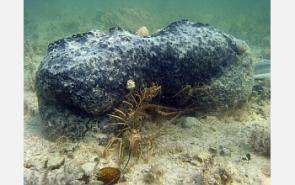
Caribbean spiny lobsters, like these young lobsters under a loggerhead sponge, are social and prefer to share dens. Infectious diseases can be more easily transmitted to animals in close proximity. Credit: Mark Butler, Old Dominion University
Caribbean spiny lobsters are able to detect illness in others of their kind, and employ avoidance tactics to keep their population healthy, according to a paper in this week's issue of the journal Nature.
The research results show that the usually social animals avoid contact with other lobsters that carry viruses--even before those lobsters become infectious.
"Pathogens that can be transmitted from animal to animal are a major threat to their populations, especially in animals that are social," said Chuck Lydeard, program director in the National Science Foundation (NSF)'s Division of Environmental Biology, which funded the research. "This is the first record of social animals avoiding diseased individuals of their own species in the wild."
Donald Behringer and Mark Butler of Old Dominion University in Norfolk, Va., and Jeffrey Shields of the Virginia Institute of Marine Science in Gloucester Point, Va., studied young Caribbean spiny lobsters, some of which were infected by a virus transmitted by physical contact and, among the smallest lobsters, via sea water.
"Spiny lobsters are social and share communal dens, so these modes of viral transmission would have devastating consequences if there were no mechanism to check its spread," the scientists wrote.
But a mechanism there is: healthy lobsters avoid close contact with sick ones. "Healthy lobsters, when choosing dens, don't move in with those infected by this virus," said Butler.
"This avoidance tactic could be the reason for the limited transmission of the disease among natural populations in the wild," said Behringer.
The virus, called PaV1, or Panulirus argus virus 1, "infects several types of tissues," said Shields, "primarily in juvenile lobsters, resulting in metabolic wasting and death."
The research showed that healthy lobsters steer clear of infected individuals even before they show disease symptoms. "We don't yet know how this early detection of infected individuals happens," said Butler.
Source: NSF
-
From lemons to lemonade: Reaction uses carbon dioxide to make carbon-based semiconductor,
33 comments
-
Thioridazine kills cancer stem cells in human while avoiding toxic side-effects of conventional cancer treatments,
3 comments
-
SpaceX private rocket blasts off for space station (Update),
42 comments
-
Landmark calculation clears the way to answering how matter is formed,
55 comments
-
Research team claims to have found evidence Lake Cheko is impact crater for Tunguska Event,
18 comments
More news stories
Manufacturing genes to attack flu virus
An international research team has manufactured a new protein that can combat deadly flu epidemics.
11 hours ago |
not rated yet |
0
|
Scientist: Evolution debate will soon be history
(AP) -- Richard Leakey predicts skepticism over evolution will soon be history. Not that the avowed atheist has any doubts himself.
May 26, 2012 |
3.4 / 5 (22) |
98
More plant species responding to global warming than previously thought
(Phys.org) -- Far more wild plant species may be responding to global warming than previous large-scale estimates have suggested.
May 22, 2012 |
4.6 / 5 (14) |
18
|
For monogamous sparrows, it doesn't pay to stray (but they do it anyway)
It's quite common for a female song sparrow to stray from her breeding partner and mate with the male next door, but a new study shows that sleeping around can be costly.
May 22, 2012 |
5 / 5 (2) |
8
|
Thousands of shellfish found dead in Peru
Thousands of crustaceans were found dead off the coast of Lima following the mystery mass death of dolphins and pelicans, the Peruvian Navy said Friday.
May 26, 2012 |
4.7 / 5 (7) |
7
Stunning image of smallest possible five-ringed structure
Scientists have created and imaged the smallest possible five-ringed structure about 100,000 times thinner than a human hair and you'll probably recognise its shape.
'Unzipped' carbon nanotubes could help energize fuel cells, batteries
Multi-walled carbon nanotubes riddled with defects and impurities on the outside could replace some of the expensive platinum catalysts used in fuel cells and metal-air batteries, according to scientists at ...
Change in developmental timing was crucial in the evolutionary shift from dinosaurs to birds: study
At first glance, it's hard to see how a common house sparrow and a Tyrannosaurus Rex might have anything in common. After all, one is a bird that weighs less than an ounce, and the other is a dinosaur that ...
Computer model used to pinpoint prime materials for efficient carbon capture
When power plants begin capturing their carbon emissions to reduce greenhouse gases and to most in the electric power industry, it's a question of when, not if it will be an expensive undertaking.
T cells 'hunt' parasites like animal predators seek prey, study shows
By pairing an intimate knowledge of immune-system function with a deep understanding of statistical physics, a cross-disciplinary team at the University of Pennsylvania has arrived at a surprising finding: T cells use a movement ...
Yale study concludes public apathy over climate change unrelated to science literacy
Are members of the public divided about climate change because they don't understand the science behind it? If Americans knew more basic science and were more proficient in technical reasoning, would public consensus match ...