First Coral Species Listed as Threatened
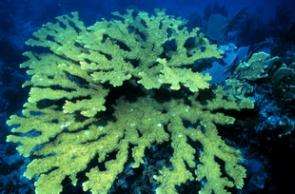
Coral reefs, the most productive and diverse marine ecosystems in the world, are based on the coral organisms that build reefs. Drastic coral declines in the last 25 years have resulted in the listing of two species, staghorn and elkhorn corals, as threatened under the U.S. Endangered Species Act (ESA).
The National Oceanographic and Atmospheric Agency (NOAA) Fisheries Service registered elkhorn (Acropora palmata) and staghorn corals (Acropora cervicornis) as threatened on May 9, 2006, with official listing effective 30 days after. This is the first time a coral has been listed as endangered or threatened under the ESA, focusing attention on the global degradation of coral reefs.
“The decline of elkhorn and staghorn corals is likely the symptom of a problem that is impacting coral reefs around the world – that problem is global warming,” said John Rollino, senior ecologist at Earth Tech, Inc. and principal investigator of Earthwatch’s Bahamian Reef Survey project. “In 2005, huge portions of the reefs in the eastern Caribbean have undergone drastic declines due to coral mortality from above average water temperatures. Some of the individual coral colonies that perished last year were alive over a hundred years ago.”
Elkhorn and staghorn corals are in the genus Acropora, the most abundant group of corals in the world and once the most important reef-building species throughout the Caribbean. Their familiar branching shapes, and relatively high growth rates for corals, offer essential habitat for fish and other reef animals that no other coral species provide. Both species have declined an estimated 90 to 98 percent since 1980.
“The loss of Acropora corals could be the first step in an unraveling coral reef ecosystem,” said Dr. Daniela Maldini, director of research at Earthwatch Institute. “Earthwatch is supporting crucially important coral reef research projects around the world to monitor this coral crisis in an effort to find solutions.”
For the last 14 years, Earthwatch teams working with scientists Tom McGrath and Dr. Garriet W. Smith, and more recently with Rollino, Smith, and colleagues, have collected data on coral decline on San Salvador, Bahamas. Elkhorn coral and staghorn coral were common at the start, forming massive, dense thickets and branching structures that provided cover for a diversity of reef fish. In recent years, however, elkhorn and staghorn corals have become practically absent from San Salvador’s reefs.
Last year witnessed a severe coral bleaching event in the Caribbean, yet another blow to Acropora populations in the region. Coral bleaching occurs when environmental stresses, like temperature change, cause symbiotic algae to be expelled from the coral polyps in which they live. If bleaching continues for an extended period, the corals will die, but bleaching is just one of the symptoms of environmental impacts on corals.
“The overwhelming majority of the decline of elkhorn and staghorn corals on San Salvador was by disease, most notably white band disease, coupled with the 1998 mass bleaching event,” said Rollino. “Regionally, their decline has resulted from several perturbations, including global warming, increased sedimentation and degraded water quality, disease, increased storm activity and damage, and/or vessel and tourism damage.”
Rollino recognizes that many of the reasons for coral decline are identified as “unmanageable” under the ESA. However, the listing will require heightened awareness and regulations for any actions that may affect corals in the U.S, from coastal development to sewage outfall. Most importantly, the ESA listing will increase public awareness of the problem and inspire public action.
“I encourage people to learn how inter-connected many of our environments are, and realize that local problems and actions may affect environments far away,” said Rollino.
He urges the public to critically review Environmental Assessments (EAs) and Environmental Impact Statements (EISs) for projects that may impact coral habitats in their region. “As someone who has authored countless EAs and EISs, I encourage people to read these documents and comment.”
Finally, Rollino urges people who see staghorn or elkhorn corals to document the location and report it immediately to NOAA and local conservation agencies. An important step in the recovery of these species will be the identification of remaining populations.
Source: Earthwatch Institute


