MESSENGER On Its Way
Aug 04, 2004
NASA rescheduled MESSENGER start to Mercury to August 3

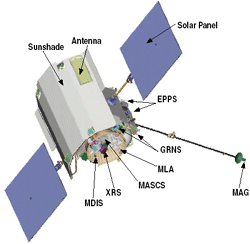
The MESSENGER spacecraft lifted off on-time aboard a Boeing Delta II rocket from pad 17-B at Cape Canaveral Air Force Station, Fla., at 2:15:56.537 a.m. EDT. MESSENGER has successfully begun its mission to unravel the mysteries of planet Mercury

MESSENGER is a scientific investigation of the planet Mercury. Understanding Mercury, and the forces that have shaped it, is fundamental to understanding the terrestrial planets and their evolution. Just what is a terrestrial planet? It is a group of planets that are like Earth.

The MESSENGER spacecraft will orbit Mercury following three flybys of that planet. The orbital phase will use the flyby information as an initial guide to perform a focused scientific investigation of this mysterious world.

On a 4.9-billion mile (7.9-billion kilometer) journey that includes 15 loops around the Sun, the solar-powered MESSENGER will fly past Earth once, Venus twice and Mercury three times before easing into orbit around its target planet. The Earth flyby, a year after launch, and the Venus flybys, in October 2006 and June 2007, use the pull of the planets’ gravity to guide MESSENGER toward Mercury’s orbit. The Mercury flybys in January 2008, October 2008 and September 2009 fine-tune and slow MESSENGER’s track while allowing the spacecraft to gather data critical to planning the mission’s orbit phase.

Primary mission at Mercury:
Orbit for one Earth year (equivalent to four Mercury years, or two Mercury solar days), collecting data on the composition and structure of Mercury’s crust, its topography and geologic history, the nature of its thin atmosphere and active magnetosphere, and the makeup of its core and polar materials.

Source: NASA

Explore further: Building a better team—on Mars

add to favorites email to friend print save as pdf

Related Stories

This spot on Mercury (almost) never goes dark

Apr 26, 2013

Mercury, traveling in its 88-day-long orbit around the Sun with basically zero axial tilt, has many craters at its poles whose insides literally never see the light of day. These permanently-shadowed locations ...

The sun sends two CMEs toward Mercury

Apr 25, 2013

On the night of April 24 and the morning of April 25, 2013, the sun erupted with two coronal mass ejections (CMEs), solar phenomena that can send billions of tons of solar particles into space that can affect ...

Astronomical pranks of April fools' past

Apr 01, 2013

The first day of April is always a traditional time for pranks and puns, and astronomers and scientists aren't above an April Fools' Day shenanigan or two. Hey, I gotta admit, as a freelance science journalist, ...

MESSENGER sees a smoother side of Mercury

Mar 22, 2013

During its two years in orbit around Mercury—as well as several more years performing flybys—the MESSENGER spacecraft has taken over 150,000 images of the innermost planet, giving us a look at its incredibly ...

Recommended for you

Building a better team—on Mars

9 minutes ago

Sometime in the next quarter-century, NASA plans to send the first humans to Mars, a mission that will push the boundaries of teamwork for a handful of astronauts who will spend as long as three years together ...

Origins of human culture linked to rapid climate change

38 minutes ago

Rapid climate change during the Middle Stone Age, between 80,000 and 40,000 years ago, during the Middle Stone Age, sparked surges in cultural innovation in early modern human populations, according to new research.

NGOs denounce Malaysia hydropower meeting

2 hours ago

Three dozen Malaysian NGOs on Tuesday denounced the world hydroelectric industry's decision to hold a conference in a Borneo state where dam projects have uprooted forests and native peoples.

User comments : 0

More news stories

Building a better team—on Mars

Sometime in the next quarter-century, NASA plans to send the first humans to Mars, a mission that will push the boundaries of teamwork for a handful of astronauts who will spend as long as three years together ...

If you can remember it, you can remember it wrong

(Medical Xpress)—Native peoples in regions where cameras are uncommon sometimes react with caution when their picture is taken. The fear that something must have been stolen from them to create the photo ...