Electrons choose another path in photosynthesis protein
In the famous Robert Frost poem, "The Road Not Taken," the persona, forced to travel one of two roads, takes the one less traveled by, and "that has made all the difference." Chemists at Washington University in St. Louis and Stanford University, in kinship with Frost, have modified a key protein in a bacterium to move electrons along a pathway not normally traveled by. They got this to happen 70 percent of the time. That yield "makes all the difference."
For years, scientists studying photosynthesis have noted that electrons in photosynthetic bacteria always choose one of two identical pathways of electron transport in the reaction center (RC) protein, which is the factory for photosynthesis. The electrons always go to one pigment , sometimes called the "right" side, shunning the left. The molecule-to-molecule movement of electrons stimulated by sunlight is called charge separation. It's the basic modus operandi of photosynthesis, whereby plants and some bacteria use sunlight to produce chemical energy. The reaction center protein is like a forest with two roads. The chemists got the electrons to take the path not traveled.
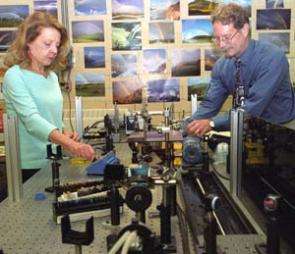
Now a husband-wife physical chemistry team at Washington University in St. Louis and their collaborators at Stanford University have created a mutant photosynthetic reaction center that passes electrons along "the road not taken." And they've done so like gangbusters. Dewey Holten, Ph.D., professor of chemistry, and Christine Kirmaier, Ph.D., research associate professor of chemistry in Arts & Sciences at Washington University in St. Louis, first got bacteria to use the other side in 1995 and got a 15 percent yield, and did so again in 1996, producing a 30 percent yield.
The find advances the understanding of photosynthesis, which is the tool plants incorporated from bacteria to evolve on Earth. Many other kinds of proteins, critical for human and other life, transfer electrons, and the findings should help shed light on how they work, among other basic issues. It also advances multi-step electron transfer processes, which could have an impact in solar energy conversions.
'Lazarus' protein
Holten and Kirmaier, of Washington University, and Steven G. Boxer, Ph.D., professor of chemistry at Stanford and his graduate student Jessica I. Chuang, made just three changes in the reaction center protein of the Rhodobacter capsulatus DLL mutant to make the electrons travel to the other side with unorthodox abandon.
The results were published in the March 28, 2006 issue of Biochemistry. It was funded by the National Science Foundation. Biochemistry highlighted the paper as one of extreme interest, and C & E News reported on it.
In the laboratory, the mutant bacteria are kept in the dark, fed sugar, and use respiration to make energy. Their oxygen exposure is kept minimal. Nonetheless, they make the reaction center protein, even though they don't use it when growing by respiration.
"This trick allows us to study RC mutations that would be fatal to the organism if it had to live by photosynthesis, " Kirmaier explained.
To get the electrons to go the other side, Holten and Kirmaier altered three amino acids.. In doing so, they were a bit like shade tree mechanics puzzling over a dead car trying to make it start.
"Even though we've been able to make electrons use the other side before, this was different because of the high yield and the fact that we started with something absolutely dead and made it work from first principles," Holten said.
"It was fun," Kirmaier said. "It's a very satisfying thing to take something that simply doesn't work and apply the knowledge you've gained over 26 years and get results."
From here the chemists intend to make other alterations in the reaction center and perhaps do some retro-engineering to make even fewer changes and achieve the same, if not higher, outcomes.
"Really, just one of the changes in redox should have been enough," said Kirmaier. "You like to keep the native system intact as much as possible to find out minimally what you have to do."
Source: Washington University in St. Louis


