Sieves put a lid on greenhouse gas
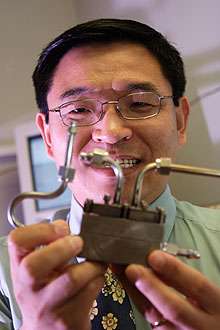
Scientists are about to test microscopic sieves that trap environmentally destructive greenhouse gases before they escape coal-fired power stations and refineries.
The new gas separation technology can be fitted to existing power stations and petrochemical plants to produce hydrogen, a clean energy carrier, and capture carbon dioxide, a greenhouse gas that worsens global warming.
Brisbane and German scientists have teamed up in a $4.2 million project to build and test this technology.
The Queensland Government today announced it would contribute $1.05 million to the project under its Smart State National and International Research Alliances program.
The scientists working on the technology are from the Australian Research Council's (ARC) Centre for Functional Nanomaterials at The University of Queensland and a German industrial research institute, Forschungszentrum Jülich (FZJ).
Professor Max Lu, the Director of the ARC Centre for Functional Nanomaterials, said the technology involved pumping synthesis gas from coal through a metal-supported molecular sieve in a pressurised chamber.
Professor Lu said the nano sieve was coated with thin film of zirconium and titanium oxides which separated hydrogen from the greenhouse gases such as carbon dioxide.
“The film we coat it in behaves like the sieve which has tiny nano-holes, one billionth of a metre, that allow the smaller hydrogen molecules to go through,” Professor Lu said.
“It will turn dirty coal use clean and leave hydrogen that can be used in many other sectors such as transportation using fuel cells.”
Water would be the only by-product for coal power stations using the sieves as the carbon dioxide could be buried and hydrogen converted into electricity in fuel cells.
The research is also supported by UQ, the Centre for Low Emission Technology which is backed by Queensland power and mining companies and FZJ, the German state of North Rhine Westphalia and German industrial partners.
Project manager Dr Joe da Costa said UQ's molecular sieve technology was cheaper and had superior engineering performance compared to conventional gas separation technologies.
Dr da Costa said it was important environmental technology especially given more than 80 percent of Australia's power came from coal-powered plants.
“Many countries have good coal resources that can last at least for another 150 years but to use that more cleanly and efficiently you have to think about new technologies,” Dr da Costa said.
“Coal is very cheap and the technology will allow our society to meet our obligation to reduce the amount of carbon dioxide that's pumped into the atmosphere.”
This is the first project to flow from a 2004 energy technology agreement signed between Queensland and North Rhine Westphalia.
Source: University of Queensland


