Hubble Catches Scattered Light From The Boomerang Nebula
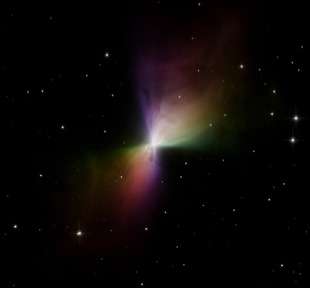
The Hubble Space Telescope has "caught" the Boomerang Nebula in these new images taken with the Advanced Camera for Surveys. This reflecting cloud of dust and gas has two nearly symmetric lobes (or cones) of matter that are being ejected from a central star.
Over the last 1,500 years, nearly one and a half times the mass of our Sun has been lost by the central star of the Boomerang Nebula in an ejection process known as a bipolar outflow.
The nebula's name is derived from its symmetric structure as seen from ground-based telescopes. Hubble's sharp view is able to resolve patterns and ripples in the nebula very close to the central star that are not visible from the ground.
Astronomers are uncertain of the cause of bipolar outflow in this, and many other, young nebulae like the Boomerang. It may be that a disk of slow-moving material is situated around the equator of the star, thereby blocking more rapidly moving ejected material there, and allowing only matter closer to the poles to be ejected.
Another consideration may be that magnetic fields are responsible for constraining the material and thus causing the double-lobed shape of the nebula.
Bipolar outflows are seen to occur both from very young stars ("protostars") that are still in the process of collapsing and forming, and from old stars nearing the ends of their lives that have become bloated red giants. The Boomerang is believed to be the ejected outer layers from an old red giant.
Each lobe of the Boomerang Nebula is nearly one light-year in length, making the total length of the nebula half as long as the distance from our Sun to our nearest neighbors - the Alpha Centauri stellar system, located roughly 4 light-years away.
These images of the Boomerang were taken in early 2005 with the Advanced Camera for Surveys onboard Hubble. A visible light filter was used in combination with a series of polarization filters.
Similar to polarizing sunglasses that are used to reduce the amount of scattered light that enters our eyes on a sunny day, the telescope's polarizing filters allow only light of a specific polarization angle to pass through to the camera's detector.
By combining images taken at different polarization angles, astronomers can study light scattering in the nebula and the properties of the small dust particles responsible for the scattering. Colors were assigned to represent different polarization components, and then those colors were adjusted to accentuate features in the nebula, resulting in the multi-hued composite image.
The Boomerang Nebula is located about 5,000 light-years from Earth in the direction of the Southern constellation Centaurus. Submillimeter radio measurements made in 1995 show the deep interior of the nebula to have a temperature of only one degree Kelvin above absolute zero, with absolute zero equal to nearly -460 degrees Fahrenheit.
This makes the inner regions of the Boomerang Nebula one of the coldest known places in the universe.
Copyright 2005 by Space Daily, Distributed United Press International
-
From lemons to lemonade: Reaction uses carbon dioxide to make carbon-based semiconductor,
32 comments
-
Thioridazine kills cancer stem cells in human while avoiding toxic side-effects of conventional cancer treatments,
3 comments
-
SpaceX private rocket blasts off for space station (Update),
42 comments
-
Climate scientists say they have solved riddle of rising sea,
31 comments
-
SpaceX capsule has 'new car' smell, astronauts say (Update),
4 comments
More news stories
Land and sea species differ in climate change response: study
(Phys.org) -- Marine and terrestrial species will likely differ in their responses to climate warming, new research by Simon Fraser University and Australia’s University of Tasmania has found.
8 hours ago |
4 / 5 (5) |
6
|
Yale study concludes public apathy over climate change unrelated to science literacy
Are members of the public divided about climate change because they don't understand the science behind it? If Americans knew more basic science and were more proficient in technical reasoning, would public consensus match ...
10 hours ago |
4.8 / 5 (6) |
24
|
10 million years needed to recover from mass extinction
It took some 10 million years for Earth to recover from the greatest mass extinction of all time, latest research has revealed.
Space & Earth / Earth Sciences
10 hours ago |
4 / 5 (4) |
1
|
Sophisticated simulations predict future warming
The chances of our planet being hit by a global warming of 3 degrees Celsius by 2050 is as likely as it being hit by an increase of 1.4 degrees, new research shows. Presented in the journal Nature Geoscience, the British study ...
Space & Earth / Earth Sciences
May 22, 2012 |
3.8 / 5 (11) |
51
Aliens don't want to eat us, says former SETI director
Alien life probably isnt interested in having us for dinner, enslaving us or laying eggs in our bellies, according to a recent statement by former SETI director Jill Tarter.
Space & Earth / Space Exploration
May 25, 2012 |
4.4 / 5 (15) |
41
'Unzipped' carbon nanotubes could help energize fuel cells, batteries
Multi-walled carbon nanotubes riddled with defects and impurities on the outside could replace some of the expensive platinum catalysts used in fuel cells and metal-air batteries, according to scientists at ...
Change in developmental timing was crucial in the evolutionary shift from dinosaurs to birds: study
At first glance, it's hard to see how a common house sparrow and a Tyrannosaurus Rex might have anything in common. After all, one is a bird that weighs less than an ounce, and the other is a dinosaur that ...
Computer model used to pinpoint prime materials for efficient carbon capture
When power plants begin capturing their carbon emissions to reduce greenhouse gases and to most in the electric power industry, it's a question of when, not if it will be an expensive undertaking.
T cells 'hunt' parasites like animal predators seek prey, study shows
By pairing an intimate knowledge of immune-system function with a deep understanding of statistical physics, a cross-disciplinary team at the University of Pennsylvania has arrived at a surprising finding: T cells use a movement ...
Stunning image of smallest possible five-ringed structure
Scientists have created and imaged the smallest possible five-ringed structure about 100,000 times thinner than a human hair and you'll probably recognise its shape.
Browser wars flare in mobile space
The browser wars are heating up again, but this time the fight is for dominance of the mobile Internet.