Antarctic’s signature dish under threat
Apr 20, 2006
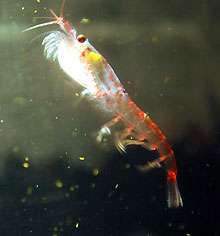
Antarctic waters teem with life thanks largely to krill. Photo: Rob King

Scientists have begun work to help explain the population decline of the Southern Ocean's most important species — Antarctic krill. The small shrimp-like creatures underpin the Antarctic marine world as the staple diet for predators from penguins to whales.

Antarctic krill are found in great abundance throughout the Southern Ocean but their numbers have decreased by up to 70 percent since the 1970s.

Environmental toxicologist Dr Susan Bengtson Nash from the National Research Centre of Environmental Toxicology (EnTox), part of The University of Queensland's Faculty of Health Sciences, wants to find out why.

Dr Bengtson Nash has gone to the Norwegian Institute of Air Research to examine 10 kilograms of Antarctic krill to see if they've absorbed man-made pollutants.

She is testing for a variety of persistent organic pollutants (POPs) which are harmful chemicals that resist degradation and accumulate in the environment and in organisms.

"I'm looking at krill as the keystone species in Antarctic food webs," Dr Bengtson Nash said.

"Most larger species feed either opportunistically or solely on the krill swarms that form during summer months.

"If you remove that species then you'll also remove a lot of other species."

Once Dr Bengtson Nash identifies what chemicals are accumulating in the krill, she will conduct toxicity tests with live krill at the Australian Antarctica Division in Hobart.

She said many POPs were moving towards colder and colder climates such as the Earth's poles.

"Polar environments essentially act as sinks for these chemicals," Dr Bengtson Nash said.

"The Artic has proportionally higher concentrations of POPs than the Antarctic because historically these chemicals were primarily produced in the northern hemisphere."

Dr Bengtson Nash is four months into her three-year Australian Research Council Discovery project.

Source: University of Queensland

Explore further: US scientist not involved in classified research: witnesses

add to favorites email to friend print save as pdf

Related Stories

Manipulating Lorentz and Fano spectral line shapes

58 minutes ago

(Phys.org) —It is widely known that the optical properties of certain materials can be modified by using lasers to control the quantum states of their optical electrons. Lasers that can generate ultra-short ...

Invasion of the slugs—halted by worms...

16 hours ago

The gardener's best friend, the earthworm, is great at protecting leaves from being chomped by slugs, suggests research in BioMed Central's open access journal BMC Ecology. Although they lurk in the soil, they seem to pro ...

Recommended for you

US scientist not involved in classified research: witnesses

May 17, 2013

Colleagues of a US scientist found hanged in Singapore last year told a coroner's inquiry Friday he was not involved in projects with military applications and was never asked to compromise any country's national security.

Healthy companies and healthy regions: Connecting the dots

May 16, 2013

In today's virtual world, it's easy to downplay the significance of place. Yet when it comes to regional prosperity, geography matters. Income and job growth is not random but rather spill over from one region to another, ...

User comments : 0

More news stories

Evolution of lying

(Phys.org) —Ultimately, our ability to convincingly lie to each other may have evolved as a direct result of our cooperative nature.

Heat-related deaths in Manhattan projected to rise

Residents of Manhattan will not just sweat harder from rising temperatures in the future, says a new study; many may die. Researchers say deaths linked to warming climate may rise some 20 percent by the 2020s, ...

Honeybees trained in Croatia to find land mines

(AP)—Mirjana Filipovic is still haunted by the land mine blast that killed her boyfriend and blew off her left leg while on a fishing trip nearly a decade ago. It happened in a field that was supposedly ...

Mice, gerbils perish in Russia space flight

A number of mice and eight gerbils sent into space in a Russian capsule destined to find out how well organisms can withstand extended flights perished during their journey, scientists said Sunday as the ...