'Word-vision' brain area confirmed
Apr 19, 2006
Brain

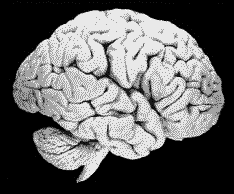
French neuroscientists have ended a long controversy, confirming a specific area of the human brain plays a causal role in our ability to recognize words.

Humans have an uncanny ability to skim through text, instantly recognizing words by their shape -- even though writing developed only about 6000 years ago, long after humans evolved. Thus, scientists have hotly debated whether an area of the cortex called the Visual Word Form Area, or VWFA, is a specific and necessary area for recognizing words.

Functional MRI scans have shown the area activates when people read, as opposed to recognizing other objects, such as faces or houses. And people with lesions in that region lose the ability to recognize whole words, reduced to letter-by-letter reading. But fMRI studies have not demonstrated a causal role for the VWFA, and lesions involving the VWFA invariably involved other regions as well.

Now, a patient whose surgery to relieve epilepsy specifically disrupted the VWFA has given researchers -- led by Laurent Cohen of the Hospital of Salpetriere in Paris -- an opportunity to demonstrate the region does indeed play a causal role in our ability to recognize words.

The research appears in the journal Neuron.

Copyright 2006 by United Press International

Explore further: You clap, so I clap: Peer pressure drives applause

add to favorites email to friend print save as pdf

Related Stories

Toxic radiation in groundwater at Fukushima: operator

1 hour ago

Cancer-causing radioactive substances have been found in groundwater at the crippled Fukushima nuclear plant, its Japanese operator said on Wednesday, as it pledged to prevent it getting into the sea.

City-life changes blackbird personalities, study shows

8 hours ago

The origins of a young animal might have a significant impact on its behavior later on in life. Researchers at the Max Planck Institute for Ornithology in Radolfzell, Germany, have been able to demonstrate ...

Origins of 'The Hoff' crab revealed (w/ Video)

8 hours ago

The history of a new type of crab, nicknamed 'The Hoff' because of its hairy chest, which lives around hydrothermal vents deep beneath the Southern Ocean and Indian Ocean, has been revealed for the first ...

Research shows moves to ban pay-to-delay deals are justified

8 hours ago

Controversial deals that delay generic versions of drugs coming onto the market can lead to consumers paying significantly more for some treatments, according to new research by an academic from the University of East Anglia ...

Recommended for you

User comments : 0

More news stories

The hidden agenda of Obama's opposition

Is the US Tea Party movement a racial backlash against President Obama? A new study by Angie Maxwell from the University of Arkansas, and Wayne Parent from Louisiana State University, assesses whether racial attitudes are ...

3D printing tiny batteries

(Phys.org) —3D printing can now be used to print lithium-ion microbatteries the size of a grain of sand. The printed microbatteries could supply electricity to tiny devices in fields from medicine to communications, ...