Deciphering Mars: Follow The Water
Why do we have such a longstanding fascination with Mars? Very simply put, it's about life. The search for life elsewhere in our solar system has been a major driver for exploring Mars, pretty much since we began seriously looking at that planet.
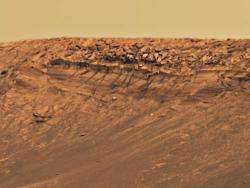
A feature called "Burns Cliff", part of the rocky outcrop in Endurance Crater. Credit: NASA/JPL
What we've adopted in the last decade or so is kind of a mantra: Follow the water. Why? Because water is a proxy for life. It's considered one of the most fundamental requirements for living systems. Now life requires more than just water.
We have to have the essential elements, the nutrients, the building blocks, and we also have to have energy resources. Taking all those things together, a new way of talking about this has emerged in recent years: the concept of habitability, the potential for an environment to be inhabited by life. This concept of habitability, along with "follow the water," has become a central theme in exploring Mars.
In the present decade, exploration efforts have been focused on this follow-the-water strategy, as well as on gaining insights into the distribution of essential building blocks and energy sources, to better understand the potential for past or present habitability. This is being accomplished through a phased program of exploration that emphasizes the interplay between orbital and surface missions.
Astrobiologist Jack Farmer discusses prospecting for martian water.
2005 is an interesting time in the exploration of Mars, because we have two rovers on the surface, Spirit and Opportunity; we have the Mars Global Surveyor orbiter, which was launched in 1998; we have Mars Odyssey, which was launched in 2001; and we have Mars Express, launched in 2003. They're all operating simultaneously. It's a very exciting time. Lots of new data are coming out of this effort, which is an international effort.
What we're learning is rewriting the textbooks and changing our perspectives about Mars. So it's a good time to ask some key questions, and to review what we think we know about the potential for astrobiology in the martian environment.
One key question that we've been asking for quite a while now is: In the past on Mars, how widespread was surface water, and over what time periods was it present? We think we have evidence that water was present in the past, particularly in the early history of Mars. How can we be more specific about that? How widespread was it? What particular kinds of environments existed, for how long, and during what periods of time in martian history?
Our approach has been to use high-resolution infrared mapping from orbit, to search for aqueously formed geomorphic features and sedimentary deposits. Mars Global Surveyor, Odyssey and Mars Express are all working on this problem in various ways, as will the just-launched Mars Reconnaissance Orbiter.
Another key question is whether water is present in the subsurface of Mars today. The approach there is to use high-resolution imaging, gamma-ray spectroscopy and radar sounding from orbit, to try to discover deposits of surface and subsurface ice and water. Again, the same missions, in various ways, are contributing to discovery. These are two really fundamental questions with regard to habitability, particularly in following in the water.
We not only have to follow it in the past on the surface, but because liquid water is unstable on the surface of Mars today, if we're going to look for liquid water today, we're going to have to go into the subsurface. So we're looking in the past for ancient deposits for evidence of past water, and in the subsurface for active environments where we might actually have biology going on.
Copyright 2005 by Space Daily, Distributed United Press International


